
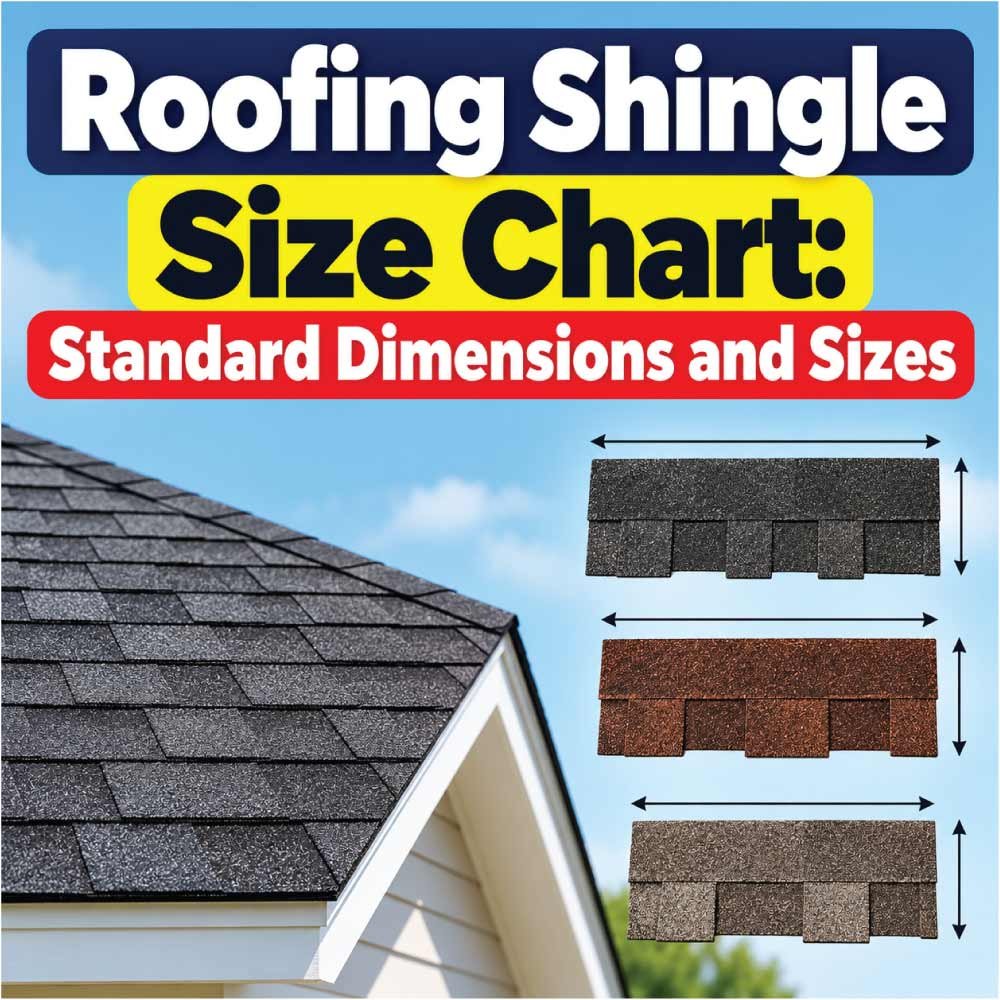
Roofing shingles come in several styles, dimensions, and configurations, so knowing the typical shingle size can make roof planning much easier. A roofing shingle size chart is useful when estimating material quantities, comparing shingle types, planning roof layouts, or deciding which shingles are appropriate for a particular project.
Although many asphalt shingles are manufactured around common dimensions, the exact size can vary by product and design. Shingle dimensions also do not tell the whole story because the exposed portion, coverage area, tab layout, and installation pattern affect how much roof surface each shingle actually covers.
This guide explains standard roofing shingle dimensions, common shingle types, coverage, bundle quantities, and the factors that influence sizing. It also includes a practical roofing shingle size chart later in the article so you can compare common dimensions without confusing the physical shingle size with its installed coverage.
What Is a Roofing Shingle Size?
Roofing shingle size refers to the overall physical dimensions of an individual shingle before it is installed. For rectangular asphalt shingles, this is generally described by length and width.
A typical asphalt shingle is roughly 12 inches wide and about 36 to 40 inches long, although exact dimensions depend on the manufacturer and shingle design. Architectural shingles can have different dimensions and shapes from traditional three-tab shingles.
The important point is that shingle size and roof coverage are not the same thing.
During installation, shingles overlap one another. Part of each shingle is covered by the course above it, while another portion remains exposed to weather. The exposed section is the part that contributes directly to the visible roof surface.
For that reason, simply multiplying a shingle’s length by its width does not give you the actual roof area covered by that shingle.
Several measurements can matter when working with roofing shingles:
- Overall shingle length
- Overall shingle width
- Exposure
- Headlap
- Course spacing
- Number of shingles per bundle
- Coverage per bundle
- Roof slope
- Shingle style and profile
Understanding these differences helps prevent mistakes when estimating materials.
Common Roofing Shingle Dimensions
Most standard asphalt roofing shingles fall within a relatively familiar dimensional range, but there is no single universal size that applies to every product.
Traditional three-tab shingles are often manufactured close to 12 inches wide and 36 inches long. Architectural or dimensional shingles may be similar in general footprint but can be thicker, heavier, and shaped differently.
The table below provides a general comparison of commonly encountered dimensions. These are typical ranges rather than universal manufacturing specifications.
| Shingle Type | Approx. Length | Approx. Width | General Profile |
|---|---|---|---|
| Three-tab asphalt | 36–40 in. | 12–13 in. | Flat, tabbed |
| Architectural asphalt | 36–40 in. | 12–14 in. | Layered, dimensional |
| Premium architectural | Varies | Varies | Heavy, dimensional |
| Starter shingle | Varies | Varies | Designed for eaves/rakes |
| Hip and ridge shingle | Varies | Varies | Narrow specialty pieces |
Actual dimensions should always be checked against the particular shingle being installed. Manufacturing variations are normal, and some specialty products use substantially different dimensions.
Three-Tab Shingle Size and Dimensions
Three-tab shingles are one of the most recognizable asphalt roofing products. They have a relatively flat appearance and feature regularly spaced cutouts that create the appearance of individual tabs after installation.
A common three-tab shingle is approximately 36 inches long and 12 inches wide, although some products may differ slightly.
The name comes from the visible tab pattern along the lower portion of the shingle. These tabs help create a consistent horizontal appearance when multiple courses are installed.
Typical three-tab shingle measurements
A general three-tab shingle may have:
- Length: about 36 inches
- Width: about 12 inches
- Exposure: commonly around 5 inches
- Several shingles per bundle
- Coverage based on the manufacturer’s specified installation pattern
The actual exposed area is much smaller than the complete surface area of the uninstalled shingle because each course overlaps the one below it.
Three-tab shingles are often selected when a straightforward, economical roofing appearance is desired. Their regular pattern also makes them relatively easy to recognize when planning a roof layout.
Architectural Shingle Size and Dimensions
Architectural shingles, sometimes called dimensional shingles, are constructed with multiple layers or laminated sections. This gives them a more textured appearance than traditional three-tab shingles.
Their overall length and width can be similar to conventional asphalt shingles, but their thickness, weight, shape, and visual profile are different.
A typical architectural shingle may be around 36 to 40 inches long and roughly 12 to 14 inches wide. However, exact measurements vary considerably between product lines.
Why architectural shingles can look larger
The dimensional structure makes architectural shingles appear more substantial after installation. Their laminated construction creates shadow lines and variation across the roof.
This does not necessarily mean the physical shingle is dramatically larger than a three-tab shingle. Instead, the additional material and layered construction create a different installed appearance.
When estimating architectural shingles, use the manufacturer’s stated coverage rather than assuming that every architectural shingle covers exactly the same area as a three-tab shingle.
Roofing Shingle Size Chart by Type
Different roofing components have different purposes, so a complete roofing shingle size chart should not treat every shingle as an ordinary rectangular field shingle.
| Roofing Shingle Type | Typical Size Range | Primary Use |
|---|---|---|
| Three-tab shingle | About 36–40 × 12–13 in. | Main roof areas |
| Architectural shingle | About 36–40 × 12–14 in. | Main roof areas |
| Starter shingle | Product-specific | Eaves and roof edges |
| Hip shingle | Product-specific | Hips |
| Ridge shingle | Product-specific | Ridges |
| Premium designer shingle | Product-specific | High-profile roofing |
| Specialty shingle | Varies widely | Decorative or specialized roofs |
This chart is intended as a dimensional reference. It should not be used as a substitute for the installation requirements of a specific roofing product.
How Roofing Shingle Exposure Affects Size
Exposure is one of the most important concepts to understand when working with roofing shingle dimensions.
The exposure is the portion of the shingle that remains visible after the next course is installed. The rest is covered by overlapping material.
For many conventional asphalt shingles, exposure is around 5 inches, although the exact requirement depends on the shingle design and installation method.
For example, imagine a shingle that is approximately 36 inches long. That does not mean the shingle creates 36 inches of vertical roof coverage. Much of its height is hidden beneath the course above.
This is why roof estimates are based on installed coverage rather than simply calculating the area of each loose shingle.
Exposure also affects the visual appearance of the roof. A smaller exposure can create more visible courses, while a larger exposure can produce fewer horizontal rows.
What Is Shingle Headlap?
Headlap is the amount by which one roofing shingle course overlaps the course beneath it in the vertical direction.
This overlap is important because roofing shingles are designed to shed water from one course to the next. Proper overlap helps prevent water from reaching the roof deck through the joints between shingles.
Headlap requirements vary according to shingle type, roof slope, installation method, and product instructions. It should not be guessed from the physical dimensions alone.
The relationship between shingle length, headlap, and exposure determines the vertical spacing of courses.
A simple way to think about it is:
Shingle length = exposed portion + covered portion
The covered portion includes the overlap required for the roofing system.
How Many Shingles Are in a Bundle?
The number of shingles in a bundle is not fixed across every product. Manufacturers package shingles according to the weight, size, construction, and coverage requirements of the particular product.
Instead of focusing only on the number of individual shingles, roofers generally pay attention to the coverage represented by a bundle.
A common industry estimating convention is that three bundles of standard asphalt shingles often cover approximately one roofing square, but this is not universal.
Some architectural, premium, or specialty shingles may require a different number of bundles per square.
Why bundle count varies
Bundle quantities can change because of:
- Shingle thickness
- Shingle weight
- Overall dimensions
- Shingle design
- Packaging requirements
- Manufacturer specifications
- Coverage per bundle
Always use the coverage printed or specified for the actual product when calculating how many bundles you need.
What Is a Roofing Square?
A roofing square is a standard unit used to describe 100 square feet of roof area.
This measurement is especially useful because roofing materials are commonly sold or estimated by the square rather than by individual shingles.
For example:
- 1 roofing square = 100 square feet
- 10 roofing squares = 1,000 square feet
- 20 roofing squares = 2,000 square feet
If a roof has a measured surface area of 2,000 square feet, the basic roof area is 20 squares before accounting for waste and additional material.
The number of bundles required then depends on the coverage provided by the selected shingles.
How to Calculate Roofing Shingle Quantity
Calculating the number of shingles begins with finding the actual roof surface area.
For a simple rectangular roof section:
Roof area = length × slope-adjusted width
For more complicated roofs, divide the roof into manageable sections, calculate each section separately, and then add the results together.
Once you have the total roof area, convert it into roofing squares:
Roofing squares = total roof area ÷ 100
After that, determine how many bundles are required based on the coverage stated for the selected shingle.
Finally, account for waste.
Why waste should be included
Roofing projects rarely use every shingle with zero leftover material. Waste can result from:
- Cutting shingles around valleys
- Working around chimneys
- Roof penetrations
- Dormers
- Complex roof shapes
- Damaged shingles
- Starter and ridge requirements
- Installation mistakes
- Future repairs
A simple roof may require less additional material than a roof with numerous angles and penetrations.
The appropriate waste allowance depends on the roof design and installation situation rather than one universal percentage.
Roof Pitch and Shingle Coverage
Roof pitch affects the amount of material required because the roof surface is larger than the horizontal footprint of the building.
Consider a building that measures 30 feet by 40 feet. Its horizontal footprint is 1,200 square feet, but the actual sloped roof surface can be larger.
The steeper the roof, the more the sloped surface differs from the horizontal measurement.
This is why roof measurements should be based on the actual roof planes whenever possible.
Roof pitch can also influence shingle installation requirements. Certain roofing products have minimum slope requirements or special installation procedures for lower-slope applications.
Before choosing a shingle, check that the product is suitable for the roof’s pitch and intended installation method.
Also Read:
Standard Shingle Sizes vs. Actual Coverage
One of the most common mistakes is assuming that a 12-by-36-inch shingle provides exactly 3 square feet of installed coverage.
The loose shingle may have an overall area close to that figure, but overlapping changes the effective coverage.
For this reason, these are two different measurements:
| Measurement | Meaning |
|---|---|
| Overall size | Physical dimensions of the loose shingle |
| Exposure | Visible portion after installation |
| Headlap | Overlap between courses |
| Bundle coverage | Roof area covered by a package |
| Square | 100 square feet of roof area |
For material estimation, bundle coverage and roofing squares are generally more useful than the raw area of an individual loose shingle.
Factors That Can Change Roofing Shingle Dimensions
Not every roofing shingle follows the same dimensional pattern. Several factors can influence the size and configuration.
Shingle design
Three-tab shingles have a regular tab pattern, while architectural shingles use layered shapes. Premium products may have even more distinctive profiles.
Manufacturer
Different manufacturers can produce shingles with different dimensions, exposure requirements, and packaging quantities.
Product line
Even within the same general category, one product may differ from another in length, width, thickness, weight, and coverage.
Installation method
The required overlap and exposure can affect how much roof surface a shingle covers after installation.
Roof design
Valleys, hips, ridges, rakes, dormers, and penetrations can change how shingles need to be cut and arranged.
Because of these variables, a generic roofing shingle size chart is best used for planning and terminology, while the product’s installation information should be used for final measurements.
Also Read:
How to Choose the Right Shingle Size
Shingle size should not be the only factor considered when selecting roofing material.
Start by determining the roof’s requirements and then compare products that are suitable for the project.
Consider the following:
- Roof pitch
- Roof shape and complexity
- Existing roofing material
- Desired appearance
- Local weather conditions
- Required installation method
- Shingle coverage
- Product weight
- Warranty requirements
- Availability of matching accessories
- Compatibility with other roofing components
A shingle that looks suitable based only on its dimensions may not be appropriate for a particular roof.
The installation system matters just as much as the physical size.
Also Read:
Common Roofing Shingle Size Mistakes
Incorrect assumptions about dimensions can create material shortages or unnecessary waste.
Using the roof footprint instead of roof surface area
The building’s footprint does not necessarily equal the actual roof area. Sloped surfaces must be accounted for.
Assuming every bundle covers the same area
Bundle coverage can vary between products. Never assume that one bundle always represents the same coverage.
Ignoring roof complexity
A simple gable roof and a complicated roof with multiple valleys will not produce the same level of cutting waste.
Confusing shingle size with exposure
A shingle’s overall length is not the same as its visible installed height.
Mixing different products
Different shingle profiles may have different installation requirements. Mixing products without considering compatibility can create layout and appearance problems.
Forgetting specialty shingles
Field shingles are not the only materials required. Starter strips, hip shingles, ridge shingles, and other accessories may be necessary depending on the roofing system.
How Shingle Size Affects Roof Appearance
Shingle dimensions and design influence the visual character of a roof.
Three-tab shingles generally produce a regular, repeating pattern. Architectural shingles create more variation because their laminated layers produce additional texture and shadow.
The visible exposure also affects the rhythm of the roof. Consistent course spacing creates an orderly appearance, while the shingle profile determines how much depth is visible.
Color is obviously important, but shape and dimensional structure can change the appearance just as significantly.
For homeowners comparing roofing options, it can be useful to look beyond the basic length and width and consider how the shingles will appear once several courses are installed.
How to Measure a Roof for Shingles
Accurate measurements are essential before purchasing roofing materials.
For a straightforward roof, you can measure each roof plane and calculate its surface area. More complicated roofs should be broken into separate sections.
A basic process is:
- Measure the length of each roof plane.
- Measure the slope-adjusted width or determine the actual sloped area.
- Calculate the area of each section.
- Add all roof sections together.
- Convert the total area into roofing squares.
- Determine shingle and bundle requirements from the product coverage.
- Add appropriate material for cutting and installation waste.
- Include starter, hip, ridge, and other required components.
For an irregular roof, a detailed roof measurement or professional estimate can reduce the chance of ordering too little or too much material.
Roofing Shingle Size FAQ
What is the standard size of an asphalt shingle?
A common asphalt shingle is approximately 36 to 40 inches long and about 12 to 14 inches wide, depending on the type and manufacturer. Three-tab shingles are often near the smaller end of this range.
Are architectural shingles the same size as three-tab shingles?
Not necessarily. Architectural shingles can have similar overall dimensions, but their shape, thickness, weight, exposure, and coverage may differ.
How many shingles cover 100 square feet?
There is no single number that applies to every shingle. Roofing products are generally estimated by bundle coverage and roofing squares rather than simply counting individual shingles.
How many bundles are in one roofing square?
Three bundles commonly correspond to approximately one roofing square for many standard asphalt shingle products, but this varies. Always use the coverage specified for the actual product.
What size are three-tab shingles?
Many three-tab asphalt shingles are approximately 36 inches long and 12 inches wide, although exact dimensions vary between products.
What size are architectural shingles?
Architectural shingles are commonly around 36 to 40 inches long and roughly 12 to 14 inches wide, but individual products can differ.
Does shingle size determine roof coverage?
Not by itself. Overlap, exposure, course spacing, shingle configuration, and bundle coverage all affect the amount of roof area covered.
Can I calculate shingles using the loose shingle dimensions?
Loose dimensions can help you understand the physical product, but they should not be the primary basis for estimating material. Use the manufacturer’s stated coverage and your calculated roof area.
Final Thoughts on Roofing Shingle Sizes
A roofing shingle size chart is a useful starting point for understanding the dimensions of common roofing materials, but the physical size of a shingle is only one part of the calculation. Installation overlap, exposure, roof pitch, bundle coverage, roof complexity, and shingle design all affect the final material requirement.
For quick reference, many conventional asphalt shingles are roughly 36 to 40 inches long and 12 to 14 inches wide. Three-tab shingles often fall near 36 by 12 inches, while architectural shingles can have somewhat different dimensions and a thicker, more dimensional construction.
When planning an actual roofing project, measure the roof surface carefully and use the coverage information for the exact shingle product. This approach gives you a much more reliable estimate than relying on a generic shingle dimension alone.
The goal is not simply to find a shingle that fits a particular measurement. The right calculation combines the shingle’s physical dimensions with its installed exposure, coverage, roof design, and application requirements.