
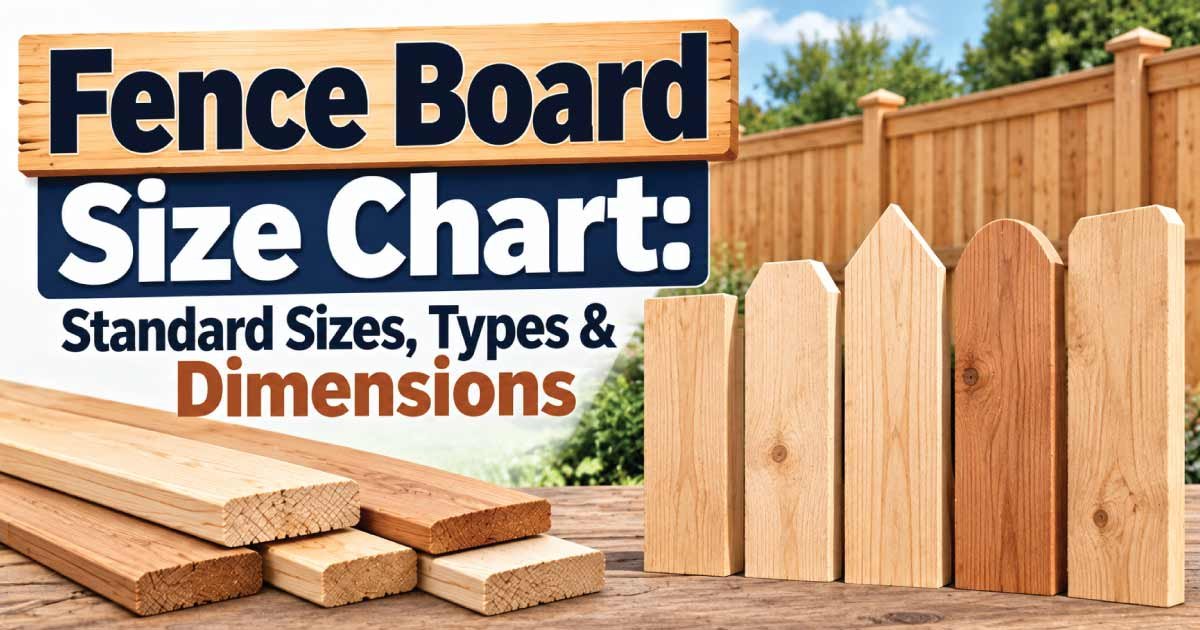
Fence boards are one of the most visible and important components of a wood fence. They create privacy, define property boundaries, improve security, and contribute significantly to the overall appearance of a yard or outdoor space. Selecting the right fence board size is important because board width, thickness, length, material, spacing, and fence height all affect the final result.
Fence boards are available in many dimensions and profiles. Common choices include 1 × 4, 1 × 6, 1 × 8, and 1 × 10 boards, although actual dimensions are smaller than the nominal sizes printed on lumber. Boards may also be sold as pickets, panels, slats, rails, or specialty fencing materials.
This fence board size chart and complete guide explains standard fence board dimensions, actual versus nominal sizes, common widths and lengths, board thickness, wood species, fence styles, spacing, material calculations, installation methods, and tips for selecting the right fence boards for your project.
What Is a Fence Board?
A fence board is a piece of lumber or manufactured material used to form the visible portion of a fence.
Depending on the fence design, boards may be installed vertically, horizontally, or in decorative patterns. They can be attached to horizontal rails, fence posts, or a supporting frame.
Fence boards can serve several purposes:
- Provide privacy
- Define property boundaries
- Improve security
- Block wind to some degree
- Create an attractive landscape feature
- Protect pets and children
- Separate different areas of a property
The correct board size depends on the fence style and the desired level of privacy.
Fence Board Size Chart
Wood fence boards are commonly available in several nominal dimensions.
| Nominal Size | Approx. Actual Thickness | Approx. Actual Width | Common Uses |
|---|---|---|---|
| 1 × 4 | 3/4 in | 3 1/2 in | Narrow pickets and decorative fences |
| 1 × 6 | 3/4 in | 5 1/2 in | Standard fence boards |
| 1 × 8 | 3/4 in | 7 1/4 in | Privacy and wider-board fences |
| 1 × 10 | 3/4 in | 9 1/4 in | Wide privacy boards |
| 1 × 12 | 3/4 in | 11 1/4 in | Extra-wide specialty applications |
| 2 × 4 | 1 1/2 in | 3 1/2 in | Rails and structural components |
| 2 × 6 | 1 1/2 in | 5 1/2 in | Heavy rails and framing |
These dimensions represent common surfaced lumber sizes. Actual dimensions can vary by manufacturer, product type, and whether the board is rough-sawn or surfaced.
For many residential fences, 1 × 6 boards are a common choice, while 1 × 4 boards provide a narrower, more decorative appearance.
Common Fence Board Widths
Fence board width affects both the appearance of the fence and the number of boards required.
3 1/2-Inch Fence Boards
A nominal 1 × 4 has an actual width of approximately 3 1/2 inches.
These narrower boards are useful for:
- Picket fences
- Decorative fencing
- Shadow-box designs
- Closely spaced boards
- Small garden fences
Because each board covers less area, more boards are needed for the same fence length.
5 1/2-Inch Fence Boards
A nominal 1 × 6 is approximately 5 1/2 inches wide.
This is one of the most versatile fence board dimensions and works well for many residential applications.
It provides a good balance between:
- Coverage
- Material usage
- Appearance
- Weight
- Availability
7 1/4-Inch Fence Boards
A nominal 1 × 8 has an actual width of approximately 7 1/4 inches.
Wider boards can create a more solid appearance and may reduce the number of boards required.
They can be useful for privacy fences and horizontal fence designs.
9 1/4-Inch Fence Boards
A nominal 1 × 10 provides approximately 9 1/4 inches of actual width.
These boards create a wide-board appearance and can be useful when fewer vertical boards are desired.
However, wider boards can experience more noticeable movement as moisture levels change.
11 1/4-Inch Fence Boards
A nominal 1 × 12 has an actual width of approximately 11 1/4 inches.
Very wide boards are less common for standard fencing but may be used for specialty designs.
Fence Board Thickness
Fence board thickness affects durability, appearance, weight, and resistance to bending.
A surfaced nominal 1-inch board is commonly about 3/4 inch thick.
| Nominal Thickness | Approx. Actual Thickness | Typical Application |
|---|---|---|
| 1 in | 3/4 in | Standard fence boards |
| 5/4 in | About 1 in | Heavy-duty fence boards |
| 2 in | 1 1/2 in | Rails and structural components |
Thicker fence boards generally feel more substantial, but they also weigh more and may cost more.
For standard vertical privacy fencing, 3/4-inch actual boards are commonly sufficient when properly supported and installed.
Nominal vs Actual Fence Board Size
Lumber dimensions are usually described using nominal sizes.
A nominal 1 × 6 board is not actually 1 inch by 6 inches after surfacing. It is typically around:
3/4 inch × 5 1/2 inches
Likewise:
1 × 4 = approximately 3/4 × 3 1/2 inches
1 × 8 = approximately 3/4 × 7 1/4 inches
1 × 10 = approximately 3/4 × 9 1/4 inches
This distinction is important when calculating fence coverage.
Always use the actual board width when determining how many boards are needed.
Standard Fence Board Lengths
Fence boards are commonly sold in several lengths.
| Common Length | Typical Use |
|---|---|
| 4 ft | Short garden and decorative fences |
| 5 ft | Medium-height fences |
| 6 ft | Standard residential fencing |
| 8 ft | Tall fences and long pickets |
| 10 ft | Horizontal fence construction |
| 12 ft | Long horizontal runs and specialty fencing |
Six-foot boards are common for many residential fence designs, but the appropriate length depends on the finished fence height and installation method.
For horizontal fences, longer boards can reduce the number of joints.
Fence Board Size by Fence Height
Fence height is an important factor when selecting board length.
| Fence Height | Common Board Length | Typical Style |
|---|---|---|
| 3 ft | 4 ft | Garden or decorative |
| 4 ft | 5 ft | Picket and boundary |
| 5 ft | 6 ft | Privacy and residential |
| 6 ft | 7–8 ft | Privacy fence |
| 7 ft | 8 ft+ | Tall privacy fencing |
| 8 ft | 10 ft+ | Specialty or high privacy |
Boards are often installed above or into the framing, so the board length does not always equal the finished fence height.
Local regulations may also limit fence height.
Fence Board Types
Different fence styles use different board shapes and arrangements.
Flat Fence Boards
Flat boards have straight edges and a simple rectangular profile.
They are commonly used for:
- Privacy fences
- Horizontal fences
- Modern fence designs
- Basic boundary fencing
Dog-Ear Fence Boards
Dog-ear boards have the upper corners cut diagonally.
They are popular for traditional privacy fences because the shaped top adds visual interest while remaining relatively simple.
French Gothic Fence Boards
These boards have a pointed or decorative top profile.
They can create a more formal appearance than flat or dog-ear boards.
Round-Top Fence Boards
The top edge is rounded rather than square or pointed.
These boards are often used for decorative fencing.
Shadow-Box Fence Boards
Shadow-box fencing uses boards on alternating sides of the rails.
This arrangement can provide privacy while creating a different appearance from each side.
Fence Board Orientation
Fence boards can be installed vertically or horizontally.
Vertical Fence Boards
Vertical boards are one of the most common residential fence designs.
Advantages include:
- Traditional appearance
- Straightforward installation
- Simple board replacement
- Easy height adjustment
- Common material availability
Horizontal Fence Boards
Horizontal fencing has become popular for modern outdoor designs.
It can provide a clean, contemporary appearance.
Longer boards are often preferred because they reduce the number of joints.
However, horizontal boards need adequate support to prevent sagging and movement.
Fence Board Spacing
The space between boards determines privacy, airflow, appearance, and material requirements.
Common spacing options include:
| Board Spacing | Privacy Level | Typical Appearance |
|---|---|---|
| 0 in | Very High | Solid privacy |
| 1/2 in | High | Nearly solid |
| 1 in | Moderate-High | Slight gaps |
| 2 in | Moderate | Open appearance |
| 3–4 in | Low | Picket-style |
| 5+ in | Very Low | Highly open |
The actual spacing should be selected according to the purpose of the fence.
If maximum privacy is required, boards can be installed tightly or in an overlapping pattern.
How Many Fence Boards Do You Need?
The number of boards depends on:
- Total fence length
- Board width
- Gap between boards
- Fence height
- Board orientation
- Fence design
For a simple vertical fence, you can use this basic calculation:
Number of boards = Fence length ÷ (Board width + Gap)
Make sure all measurements use the same unit.
For example, a 100-foot fence using 5 1/2-inch-wide boards with a 1/2-inch gap has a combined coverage of:
5.5 + 0.5 = 6 inches
A 100-foot fence contains:
100 × 12 = 1,200 inches
Then:
1,200 ÷ 6 = 200 boards
Additional boards should be purchased for cutting, defects, and replacement pieces.
Fence Board Coverage Calculation
Board width has a major effect on material requirements.
Suppose two fences are both 100 feet long.
A 1 × 4 board provides approximately 3.5 inches of actual width.
A 1 × 6 board provides approximately 5.5 inches.
The wider board covers more of the fence surface per piece.
Therefore, wider boards can reduce the total number of individual boards required.
However, wider boards may also cost more per piece and may have different movement characteristics.
Fence Board Material Options
Wood is the traditional fencing material, but several options are available.
Pine Fence Boards
Pine is widely used because it is relatively affordable and easy to work with.
For outdoor fencing, the selected pine product should be appropriate for exterior exposure.
Cedar Fence Boards
Cedar is popular for fences because of its appearance and natural characteristics.
It is often selected for:
- Privacy fencing
- Decorative fencing
- Premium outdoor projects
Redwood Fence Boards
Redwood provides a distinctive appearance and is used for higher-end fencing in regions where it is readily available.
Pressure-Treated Wood
Pressure-treated lumber is commonly used where resistance to decay and insects is important.
The appropriate treatment category depends on the intended application.
Composite Fence Boards
Composite fencing can provide a wood-like appearance while requiring less maintenance than many traditional wood products.
Dimensions vary significantly by manufacturer.
Fence Board Species Comparison
| Material | Appearance | Maintenance | Typical Cost |
|---|---|---|---|
| Pine | Light | Moderate | Low |
| Cedar | Natural reddish/brown | Moderate | Medium |
| Redwood | Rich red tones | Moderate | Medium–High |
| Treated wood | Variable | Moderate | Low–Medium |
| Composite | Wood-like | Low | Medium–High |
Actual costs vary based on region, grade, treatment, availability, and product quality.
Fence Board Grade and Quality
Not all fence boards are manufactured to the same quality level.
Look for boards that are reasonably straight and free from severe defects.
Potential issues include:
- Excessive knots
- Large splits
- Severe warping
- Deep cracks
- Excessive checking
- Rot
- Insect damage
Some knots and natural imperfections are normal in exterior lumber.
The acceptable appearance depends on whether the fence is functional, decorative, or intended as a premium architectural feature.
Fence Board Moisture and Weather Exposure
Outdoor fencing is exposed to rain, sunlight, humidity, and changing temperatures.
Wood naturally absorbs and releases moisture, which can cause:
- Shrinking
- Swelling
- Cupping
- Warping
- Cracking
- Checking
Proper installation and material selection can reduce problems.
For exterior wood fencing, allow the material to reach an appropriate moisture condition before installation when recommended by the lumber supplier or manufacturer.
Also Read:
How to Choose the Right Fence Board Size
Choosing the right fence board involves more than selecting a width.
Start With Fence Height
Determine the desired finished height before selecting board length.
Choose the Board Width
Narrow boards create a more traditional picket appearance.
Wider boards provide greater coverage per board.
Determine the Spacing
Decide whether you want:
- Solid privacy
- Partial privacy
- Open fencing
- Decorative spacing
Consider the Fence Style
A dog-ear board may be better suited to a traditional privacy fence, while flat boards can complement a modern design.
Consider the Climate
In wet or humid environments, moisture resistance and proper finishing become particularly important.
Consider Maintenance
Some homeowners prefer natural wood and are comfortable maintaining it. Others prefer manufactured materials with lower maintenance requirements.
Fence Boards for Privacy Fences
Privacy fences generally use closely spaced boards.
Common options include:
- 1 × 6 boards
- 1 × 8 boards
- Dog-ear boards
- Board-on-board construction
- Shadow-box construction
- Horizontal privacy boards
A board-on-board design places boards on alternating sides of the rails, reducing direct sightlines through the fence.
This can provide a more private appearance than a simple spaced-board design.
Also Read:
Fence Boards for Picket Fences
Picket fences generally use narrower boards with larger gaps.
Typical board widths can include:
- 3 1/2 inches
- 5 1/2 inches
Picket fences are often shorter and more decorative than privacy fences.
The top profile can be:
- Square
- Dog-ear
- Pointed
- Gothic
- Round
- Decorative
Fence Boards for Horizontal Fences
Horizontal fences generally require longer boards.
Common board widths include:
| Board Size | Approx. Actual Width | Common Horizontal Use |
|---|---|---|
| 1 × 4 | 3 1/2 in | Narrow modern slats |
| 1 × 6 | 5 1/2 in | Standard horizontal fencing |
| 1 × 8 | 7 1/4 in | Wider horizontal boards |
| 1 × 10 | 9 1/4 in | Wide-board designs |
Longer boards can create fewer joints, but they must be adequately supported.
The framing system should be designed to prevent excessive sagging.
Also Read:
Fence Board Installation Tips
Good installation improves fence appearance and durability.
Keep Boards Aligned
Use a level and consistent reference line to maintain a straight fence top.
Maintain Consistent Spacing
A spacer block can help keep gaps uniform.
Avoid Ground Contact
Where appropriate, keep wood fence boards above the soil to reduce prolonged moisture exposure.
Use Appropriate Fasteners
Exterior fencing requires fasteners compatible with the wood and environmental conditions.
Protect Cut Ends
Cut ends can absorb moisture more readily. Use an appropriate exterior treatment when recommended.
Inspect the Posts
Fence boards cannot compensate for weak or poorly installed posts.
The fence posts and supporting structure should be secure before boards are attached.
Fence Board Fastening
Fasteners should be selected based on the fence material, climate, and exposure.
Common fastening methods include:
- Exterior-rated nails
- Corrosion-resistant screws
- Pneumatic fencing nails
- Manufacturer-specified fasteners
In areas with significant moisture exposure, corrosion-resistant fasteners are especially important.
Fasteners should be installed without excessively crushing the wood surface.
Fence Board Maintenance
Wood fencing requires periodic inspection.
Look for:
- Rot
- Loose boards
- Cracked boards
- Warping
- Insect damage
- Loose fasteners
- Peeling finish
- Soil contact
Maintenance may include cleaning, staining, sealing, painting, or replacing damaged boards.
Manufactured composite fencing generally has different maintenance requirements and should be maintained according to the manufacturer’s instructions.
Common Fence Board Mistakes
Using Nominal Width in Calculations
A 1 × 6 is approximately 5 1/2 inches wide, not 6 inches.
Using 6 inches in spacing calculations can cause material estimates to be incorrect.
Ignoring Gaps
A fence with 1-inch gaps requires significantly fewer boards than a solid fence.
Always include spacing in your calculation.
Choosing Boards That Are Too Short
Board length should accommodate the desired fence height and installation details.
Installing Wood Directly Against Soil
Constant ground contact can increase moisture exposure and deterioration.
Using Interior Lumber
Interior-grade lumber is not automatically suitable for exterior fencing.
Ignoring Fence Posts
Strong boards cannot make up for poorly supported posts.
Using Incompatible Fasteners
Some fasteners can corrode or react with certain treated lumber products.
Fence Board Size Comparison
| Nominal Size | Actual Width | Coverage | Best For |
|---|---|---|---|
| 1 × 4 | 3 1/2 in | Low per board | Picket and decorative fences |
| 1 × 6 | 5 1/2 in | Medium | General residential fencing |
| 1 × 8 | 7 1/4 in | High | Privacy fences |
| 1 × 10 | 9 1/4 in | Very High | Wide-board designs |
| 1 × 12 | 11 1/4 in | Very High | Specialty applications |
Wider boards can cover more area, but the best choice depends on fence style, availability, cost, and expected movement.
Fence Board vs Fence Picket
The terms fence board and fence picket are sometimes used interchangeably.
However, a picket generally refers to an individual vertical fence member, often with a decorative or shaped top.
A fence board can be a broader term covering rectangular boards used in both vertical and horizontal fencing.
A picket may be:
- Flat
- Dog-ear
- Pointed
- Gothic
- Round-top
The terminology can vary between suppliers and regions.
Fence Board vs Fence Rail
Fence boards and rails perform different functions.
Fence boards form the visible fence surface.
Fence rails support the boards and transfer loads toward the posts.
A typical wood fence may contain:
- Fence posts
- Top rails
- Middle rails
- Bottom rails
- Fence boards
- Post caps
- Gates
- Hardware
The board dimensions should be coordinated with the supporting rails.
Estimating Fence Board Costs
Fence material cost depends on more than board size.
Factors include:
- Wood species
- Board width
- Board length
- Thickness
- Grade
- Treatment
- Finish
- Local availability
- Fence height
- Spacing
- Total fence length
Wider boards may cost more individually but can reduce the number of boards required.
Therefore, compare the cost per square foot or linear foot of coverage, rather than only the price of one board.
Fence Board Buying Checklist
Before buying fence boards, confirm:
- Finished fence height
- Board width
- Actual thickness
- Board length
- Fence style
- Board spacing
- Wood species
- Exterior suitability
- Treatment requirements
- Required quantity
- Cutting allowance
- Fastener compatibility
- Local fence-height requirements
Buying a small amount of extra material is often useful because individual boards can contain defects or become damaged during installation.
Quick Fence Board Size Reference
| Project | Recommended Starting Board |
|---|---|
| Small garden fence | 1 × 4 |
| Traditional picket fence | 1 × 4 or 1 × 6 |
| Standard privacy fence | 1 × 6 |
| Wide-board privacy fence | 1 × 8 |
| Modern horizontal fence | 1 × 6 or 1 × 8 |
| Extra-wide design | 1 × 10 |
| Heavy-duty framing | 2 × 4 or larger |
These are general starting points rather than structural specifications. Fence design should account for local conditions, wind exposure, soil, post spacing, and the supporting structure.
Frequently Asked Questions About Fence Board Sizes
What is the most common fence board size?
A nominal 1 × 6, with an actual width of approximately 5 1/2 inches, is a common choice for residential wood fencing. Other sizes may be better depending on the fence style.
What size board is best for a privacy fence?
A 1 × 6 or 1 × 8 can work well for many privacy fence designs. The best choice depends on the desired appearance, spacing, fence height, and material availability.
How wide are standard fence boards?
Common nominal widths include 4, 6, 8, 10, and 12 inches. Their actual surfaced widths are typically about 3 1/2, 5 1/2, 7 1/4, 9 1/4, and 11 1/4 inches respectively.
How thick are fence boards?
Many standard wood fence boards are approximately 3/4 inch thick after surfacing. Heavier products may be thicker.
What length should fence boards be?
Board length depends on the finished fence height and installation design. Six-foot boards are commonly used for many residential fences, while taller fences may require longer boards.
Should fence boards touch each other?
They can, but they do not have to. Solid fences may use closely spaced or overlapping boards, while picket and decorative fences intentionally use gaps.
How much space should be between fence boards?
Common gaps range from about 1/2 inch to several inches, depending on privacy and design requirements. Board movement should also be considered when deciding on spacing.
Which is better for fencing: cedar or pine?
Both can work well. Cedar is often chosen for its natural appearance and outdoor characteristics, while pine is commonly selected for affordability and availability.
Can 1 × 8 boards be used for fencing?
Yes. A nominal 1 × 8 provides approximately 7 1/4 inches of actual width and can be used for privacy and wide-board fence designs.
How do I calculate the number of fence boards needed?
Measure the total fence length, convert it to the same unit as the board width, add the desired spacing to the board width, and divide the total fence length by the combined coverage per board.
Final Thoughts on Fence Board Sizes
Selecting the right fence board size depends on the fence’s purpose, height, style, spacing, material, and supporting structure. Common lumber choices include 1 × 4, 1 × 6, 1 × 8, and 1 × 10, with each providing a different combination of coverage and appearance.
For many residential projects, a 1 × 6 is a practical starting point because it offers a balance between board width, coverage, availability, and appearance. A 1 × 4 can create a lighter picket-style fence, while 1 × 8 or 1 × 10 boards can provide a wider and more substantial privacy appearance.
Remember that nominal lumber dimensions are not the same as actual dimensions. A nominal 1 × 6 is typically about 3/4 × 5 1/2 inches, so calculations should always use the actual width.
Before purchasing materials, determine the finished fence height, total fence length, board spacing, board orientation, wood species, and required support. Also account for cutting waste and inspect boards for defects before installation.
With accurate measurements and the right board dimensions, you can create a fence that provides the desired privacy and appearance while using materials efficiently.