
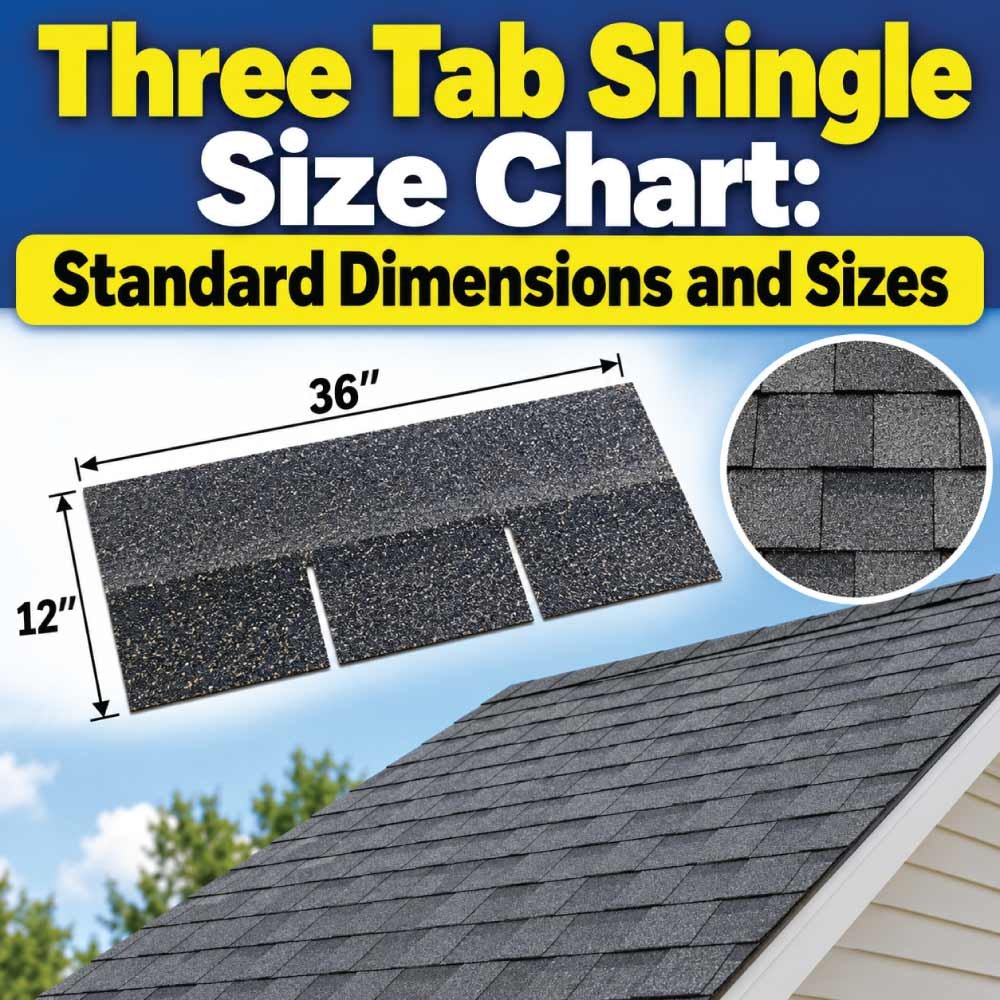
Three tab shingles are one of the most recognizable asphalt roofing materials, but their dimensions can be confusing because the overall shingle size is different from the portion that remains exposed after installation. A three tab shingle size chart makes it easier to understand the relationship between shingle length, width, tab size, exposure, and coverage.
Most standard three-tab asphalt shingles are manufactured in a nominal size of about 12 inches wide by 36 inches long, although exact dimensions can vary slightly by manufacturer and product line. Each shingle has three individual tabs, creating the familiar repeated pattern across the roof. The installed exposure is commonly around 5 inches, while the remaining portion is covered by the next course.
This guide explains standard three tab shingle dimensions, tab measurements, coverage, bundle quantities, installation layout, and the factors that can affect actual roof calculations. It also includes a practical three tab shingle size chart so you can quickly compare the measurements that matter when planning a roofing project.
What Is a Three Tab Shingle?
A three-tab shingle is a type of asphalt roofing shingle designed with three evenly spaced cutouts, or slots, along its lower edge. These cutouts divide the visible portion of the shingle into three separate tabs.
The design creates a relatively uniform, repeating appearance after installation. Unlike architectural shingles, which usually have a dimensional or layered appearance, three-tab shingles have a flatter and more consistent profile.
A typical three-tab shingle consists of:
- An asphalt-coated fiberglass base
- Asphalt material that provides weather resistance
- Mineral granules on the exposed surface
- Three visible tabs
- A concealed portion used for overlapping
- A nailing area near the upper portion of the shingle
The three-tab design also affects how the shingles are positioned from one course to the next. The installer must maintain the appropriate exposure and offset so that the joints between tabs do not line up vertically.
Because dimensions vary between products, the manufacturer’s installation instructions should always be used for the exact shingle being installed.
Standard Three Tab Shingle Dimensions
The most commonly encountered three-tab shingle has an overall dimension of approximately 12 inches by 36 inches.
That means an individual shingle is roughly 1 foot wide and 3 feet long before installation. However, the entire 36-inch length is not visible after the shingle is installed. A portion is covered by the course above it.
The basic dimensions commonly associated with a standard three-tab shingle are shown below.
| Dimension | Typical Measurement | Purpose |
|---|---|---|
| Overall width | About 12 in | Full shingle width |
| Overall length | About 36 in | Full shingle length |
| Number of tabs | 3 | Creates visible pattern |
| Tab width | About 12 in | Width of each visible tab |
| Typical exposure | About 5 in | Portion visible after installation |
| Covered portion | Remaining length | Provides overlap and weather protection |
| Nominal area before overlap | About 3 sq. ft. | Geometric size of one shingle |
These measurements should be treated as common dimensions rather than universal specifications. Modern products can have slightly different actual measurements.
Three Tab Shingle Size Chart
The following chart summarizes the measurements most useful when identifying or planning around three-tab shingles.
| Shingle Measurement | Common Size or Description |
|---|---|
| Overall shingle length | Approximately 36 in |
| Overall shingle width | Approximately 12 in |
| Overall size | Approximately 12 × 36 in |
| Number of tabs | 3 |
| Individual tab width | Approximately 12 in |
| Typical installed exposure | Approximately 5 in |
| Approximate visible area per course | 12 × 5 in per tab |
| Nominal geometric area | Approximately 3 sq. ft. |
| Typical bundle coverage | Often around 33⅓ sq. ft. |
| Common shingles per bundle | Often 20 |
| Typical bundles per roofing square | About 3 |
| Roofing square | 100 sq. ft. |
The bundle and coverage figures are particularly important because they can vary according to the product. Some shingles may require different quantities to cover a roofing square.
Understanding Three Tab Shingle Length and Width
The overall length and width describe the shingle before it is installed.
A nominal 12-inch width means the shingle spans approximately one foot horizontally. Because each shingle contains three tabs, each tab is roughly one-third of the total shingle width.
A nominal 36-inch length means the shingle extends approximately 3 feet from its top edge to its lower edge.
However, roofing calculations cannot simply assume that all 36 inches remain visible. The upper part of a shingle is covered by the shingle course above it. This overlap is essential because it creates multiple layers of material across portions of the roof.
The result is a roof surface where the installed exposure is much shorter than the shingle’s overall length.
Why the Exposure Is Smaller Than the Shingle Length
If a three-tab shingle is approximately 36 inches long but has an exposure of around 5 inches, most of the shingle length is hidden beneath subsequent courses.
This overlapping arrangement serves several purposes:
- It helps shed rainwater.
- It covers fasteners placed in the designated nailing area.
- It creates multiple layers over vulnerable areas.
- It establishes a consistent visual pattern.
- It helps maintain the intended weather-resistant installation.
For this reason, the shingle’s overall dimensions and installed dimensions should never be treated as the same measurement.
Three Tab Shingle Tab Dimensions
The word “tab” refers to the individual visible section created by the cutouts along the lower edge.
With a nominal 36-inch-wide? No—the standard three-tab shingle is approximately 12 inches wide and 36 inches long, and its three tabs are arranged across the 12-inch width.
Each tab is therefore roughly 12 inches wide, although the exact dimensions and cutout geometry can differ between products.
The tab length is associated with the visible exposure. A common exposure is approximately 5 inches, but this should be confirmed against the particular shingle’s installation instructions.
The cutouts between tabs are important because they determine the appearance of the finished roof. They also establish the horizontal joints and help produce the characteristic three-tab pattern.
Three Tab Shingles vs. Architectural Shingles
Three-tab and architectural shingles are both asphalt roofing products, but their construction and appearance are different.
Three-tab shingles have a uniform shape with three clearly defined tabs. Architectural shingles generally have a more varied profile created by multiple layers of asphalt-coated material.
| Feature | Three Tab Shingles | Architectural Shingles |
|---|---|---|
| Basic appearance | Flat and repetitive | Layered and dimensional |
| Tab pattern | Three defined tabs | Usually no simple three-tab pattern |
| Shape | Uniform | More varied |
| Typical installation pattern | Regular | Dimensional |
| Weight | Often lighter | Often heavier |
| Design | Simple | More textured |
| Dimensions | Relatively uniform | Vary considerably by product |
| Coverage calculation | Based on product and exposure | Based on product and exposure |
The exact dimensions of architectural shingles can vary substantially, so a three tab shingle size chart should not be used to calculate architectural shingle quantities.
How Many Three Tab Shingles Are in a Bundle?
A common packaging arrangement is 20 three-tab shingles per bundle, with approximately three bundles covering one roofing square.
However, this is not a rule that applies to every product.
The number of shingles required per bundle depends on the manufacturer’s design, shingle dimensions, exposure, and packaging method. Some products may contain a different number of pieces while still being designed to provide a similar amount of coverage.
For estimating purposes, the important figure is the stated coverage per bundle rather than simply counting shingles.
A roofing square represents 100 square feet of roof area. If a product provides approximately 33⅓ square feet of coverage per bundle, three bundles would provide roughly one square before accounting for additional material needed for waste and special areas.
How Much Area Does One Three Tab Shingle Cover?
A 12 × 36-inch shingle has a geometric area of:
12 × 36 = 432 square inches
Since there are 144 square inches in one square foot:
432 ÷ 144 = 3 square feet
So, geometrically, a 12 × 36-inch shingle occupies approximately 3 square feet.
But that does not mean one shingle provides 3 square feet of finished roof coverage.
The shingles overlap, so only a portion of each shingle contributes to the exposed roof surface. This distinction is essential when estimating how many shingles are needed.
The actual coverage should therefore be based on the product’s stated installation exposure and coverage information.
How Three Tab Shingle Exposure Works
Exposure is the amount of shingle that remains visible after the next course has been installed.
For a typical three-tab installation, exposure may be approximately 5 inches.
Imagine a roof covered with horizontal courses. The first course is positioned along the lower edge, and subsequent courses are installed above it. Each new course overlaps the one below.
The repeated exposure creates horizontal rows of visible tabs.
A simplified concept looks like this:
36-inch shingle length → approximately 5-inch visible exposure per course
The remaining length is used for overlap and fastening.
Because exposure directly affects how many courses are required to cover a roof slope, even a relatively small change in exposure can affect material calculations. That is why the specified exposure for the exact product should be followed rather than assuming every three-tab shingle uses exactly the same layout.
Three Tab Shingle Coverage by Bundle
For basic estimating, bundle coverage is usually more useful than the number of shingles in a bundle.
| Coverage Measure | Typical Figure |
|---|---|
| One roofing square | 100 sq. ft. |
| Approximate bundles per square | 3 |
| Approximate coverage per bundle | 33⅓ sq. ft. |
| Approximate geometric area of 12 × 36 in shingle | 3 sq. ft. |
| Actual installed coverage | Depends on exposure and product |
A roofing contractor or homeowner should check the product packaging for the actual coverage rating.
Roof calculations also need to account for starter shingles, ridge material, valleys, roof penetrations, cutting, and waste. These areas cannot always be calculated by treating every shingle as a full rectangular piece.
How to Calculate Three Tab Shingles for a Roof
The simplest starting point is to determine the total roof surface area.
For a basic rectangular roof plane:
Roof area = length × slope length
If there are multiple roof planes, calculate each plane separately and then add the results.
Once the total area is known, divide it by 100 to convert square feet into roofing squares.
For example, suppose the total measured roof area is 2,000 square feet:
2,000 ÷ 100 = 20 roofing squares
If a particular three-tab shingle product covers approximately 33⅓ square feet per bundle, the theoretical requirement would be around:
20 × 3 = 60 bundles
That is only a basic material estimate. Additional material may be needed because of cutting, valleys, hips, starter courses, ridge areas, and other installation details.
Allowing for Waste
Waste is not identical on every roof.
A simple roof with large rectangular planes may have relatively little cutting. A roof containing many valleys, dormers, hips, intersecting sections, and penetrations can require more cuts and therefore more material.
Instead of applying an arbitrary waste figure to every project, consider:
- Roof complexity
- Number of roof planes
- Valley construction
- Hip and ridge configuration
- Number of penetrations
- Starter requirements
- Shingle pattern and layout
- Product-specific installation requirements
For a precise quantity, the actual roof layout should be measured and planned.
Three Tab Shingle Roof Layout
Three-tab shingles are normally installed in horizontal courses, but the courses should not have their vertical joints aligned.
The installer uses an appropriate offset between courses to create a staggered pattern. This helps prevent continuous vertical seams running through several layers.
The first course is particularly important because it establishes the position of the rest of the shingles. Starter material is commonly used along the lower edge, followed by the regular shingle courses.
A typical installation sequence involves:
- Preparing the roof deck.
- Installing the required underlayment and edge details.
- Installing starter material.
- Establishing the correct shingle exposure.
- Installing the first regular course.
- Following the specified offset for succeeding courses.
- Fastening each shingle in the manufacturer’s designated nailing area.
- Installing shingles around valleys and penetrations according to the roof design.
- Finishing hips and ridges with appropriate materials.
The precise fastening pattern and layout should always follow the instructions for the particular product and the applicable local requirements.
Three Tab Shingle Size for Different Roof Areas
Although the basic shingle size remains relatively consistent, the way shingles are used changes depending on the roof section.
Field Areas
Large open roof sections are where standard three-tab shingles are most efficiently used. The repeated 12-inch-wide pattern allows courses to progress across the roof in a predictable manner.
Roof Edges
Eaves and rakes require special attention because shingles must meet edge-related details and starter materials. The regular shingle dimensions do not eliminate the need for proper edge preparation.
Valleys
Valleys can require additional cutting or specialized installation methods. Because shingles must accommodate the intersection of two roof planes, the number of usable full pieces can be reduced.
Hips and Ridges
Regular field shingles are not necessarily used as the final exposed material along hips and ridges. Appropriate ridge or cap material is normally required according to the roofing system.
Also Read:
Factors That Affect Three Tab Shingle Dimensions
Not every shingle labeled “three tab” will have exactly the same physical measurements.
Several factors can affect dimensions and coverage.
Manufacturer Design
Manufacturers may use slightly different shingle lengths, widths, cutout shapes, and tab proportions.
Product Line
Different versions within the same general category can have different construction and installation requirements.
Exposure Requirement
The specified exposure affects the number of courses needed and therefore the effective coverage.
Regional Practices
Roofing practices can differ according to climate, building requirements, and local construction methods. Installation instructions should therefore be matched to the location and product.
Manufacturing Tolerances
Actual physical dimensions may differ slightly from nominal dimensions because roofing products are manufactured materials rather than perfectly dimensioned rigid sheets.
For these reasons, a three tab shingle size chart is best used as a planning reference rather than a replacement for the product’s exact specifications.
Also Read:
Common Mistakes When Measuring Three Tab Shingles
One of the most common errors is assuming the overall shingle area equals the finished roof coverage.
A 12 × 36-inch shingle has approximately 3 square feet of geometric area, but overlap reduces the amount of roof surface covered by each individual piece.
Other mistakes include:
- Measuring only one roof plane
- Forgetting to account for slope
- Ignoring valleys and roof intersections
- Assuming every bundle contains the same number of shingles
- Using the geometric shingle area instead of stated coverage
- Forgetting starter and ridge materials
- Applying an arbitrary waste allowance
- Ignoring the manufacturer’s specified exposure
- Mixing products with different dimensions or installation requirements
Careful measurement before purchasing materials can prevent both shortages and unnecessary excess.
How to Read a Three Tab Shingle Size Chart
A size chart becomes much easier to use once the measurements are separated into three categories: physical size, visible size, and coverage.
Physical size describes the actual dimensions of the shingle before installation.
Visible size refers to the portion that can be seen once the shingles are overlapped.
Coverage describes how much roof area a specified quantity of shingles can cover under the intended installation method.
For example, a shingle can be approximately 12 × 36 inches while having an exposure of approximately 5 inches. There is no contradiction between these numbers because they describe different aspects of the same shingle.
This distinction is especially important for homeowners comparing roofing materials or estimating the quantity required for a replacement project.
Also Read:
Three Tab Shingle Size Chart vs. Roofing Square
A roofing square is a unit of roof area rather than a shingle dimension.
One roofing square equals 100 square feet.
This is why roofing materials are often discussed in squares instead of individual pieces.
| Measurement | Meaning |
|---|---|
| Inch | Used for individual shingle dimensions |
| Square foot | Used for roof surface area |
| Roofing square | 100 square feet of roof area |
| Bundle | Packaging unit for shingles |
| Exposure | Visible portion after installation |
| Course | A horizontal row of shingles |
Understanding these terms prevents confusion when converting between a roof measurement and the amount of material required.
Tips for Choosing the Correct Three Tab Shingle Size
If you are replacing an existing roof, do not select shingles based solely on appearance.
Check the actual product dimensions and installation requirements. If you are matching an existing roof, compare the tab width, cutout pattern, exposure, and overall dimensions.
It is also useful to consider:
- Roof pitch
- Local weather conditions
- Existing roof construction
- Compatibility with other roofing materials
- Required underlayment and flashing details
- Manufacturer installation requirements
- Local building requirements
- Availability of matching accessories
If the roof has an unusual slope or complicated geometry, accurate measurement becomes even more important.
Three Tab Shingles for Roof Replacement
When replacing an existing three-tab roof, the existing shingle size can provide a useful starting point, but it should not be assumed that a new product has identical dimensions.
Older shingles may have different physical dimensions or exposure requirements from currently available products. Even when two products appear nearly identical, their installation details can differ.
If matching an existing roof, compare:
- Overall shingle width
- Overall shingle length
- Tab width
- Cutout dimensions
- Exposure
- Color and surface appearance
- Installation requirements
A visual match alone does not guarantee dimensional compatibility.
Maintenance Considerations for Three Tab Shingle Roofs
The dimensions of a shingle do not determine how well a roof performs over time. Proper installation, ventilation, roof design, weather exposure, and maintenance all play important roles.
Regular visual inspections can help identify obvious problems such as:
- Missing shingles
- Lifted edges
- Damaged tabs
- Exposed fasteners
- Granule accumulation
- Damaged flashing
- Debris buildup
- Signs of water entry
Small problems can become more difficult to address if they are ignored. Roof inspections should be approached carefully, especially on steep slopes, and professional assistance may be appropriate when the roof cannot be safely accessed.
Frequently Asked Questions About Three Tab Shingle Sizes
What is the standard size of a three-tab shingle?
A commonly encountered three-tab shingle is approximately 12 inches wide by 36 inches long. Actual dimensions can vary by manufacturer and product.
How many tabs does a three-tab shingle have?
As the name suggests, it has three visible tabs across its width. The cutouts between the tabs create the characteristic repeating pattern.
What is the typical exposure of a three-tab shingle?
An exposure of approximately 5 inches is common, but the exact exposure must be confirmed from the installation requirements for the specific product.
How many three-tab shingles are needed for 100 square feet?
A roofing square is 100 square feet, and many common three-tab products require approximately three bundles per square. The exact quantity depends on the product’s coverage rating.
Are all three-tab shingles the same size?
No. Many products are close to the common 12 × 36-inch nominal size, but exact dimensions, tab geometry, exposure, and bundle coverage can vary.
Does a 12 × 36-inch shingle cover exactly 3 square feet?
Its geometric area is approximately 3 square feet, but its installed roof coverage is lower because shingles overlap. Use the product’s stated coverage rather than calculating coverage from overall dimensions alone.
Can three-tab shingles be used on every roof?
Suitability depends on the roof design, slope, climate, construction, and applicable requirements. The specific roofing product must be approved for the intended application.
How wide is each tab on a three-tab shingle?
On a nominal 12-inch-wide three-tab shingle, each of the three tabs is roughly 12 inches wide. Exact tab and cutout dimensions can vary.
Why do three-tab shingles overlap?
Overlap creates layered courses that help direct water down the roof while covering the fastening area and maintaining the intended weather-resistant roofing assembly.
Is three-tab shingle size the same as architectural shingle size?
No. Architectural shingles have a different construction and can vary considerably in dimensions and installation exposure. Their coverage should be calculated using the specifications for that particular product.
Final Takeaway
A three tab shingle size chart is useful for understanding the measurements behind one of the most straightforward asphalt roofing designs. A common three-tab shingle is approximately 12 inches wide and 36 inches long, with three tabs across its width and a typical installed exposure of around 5 inches.
The most important point is that overall dimensions do not equal installed roof coverage. Overlapping courses, exposure, roof geometry, valleys, edges, and packaging all affect the quantity required for a project.
For preliminary planning, remember these core measurements:
Overall size: approximately 12 × 36 inches
Number of tabs: 3
Typical tab width: approximately 12 inches
Typical exposure: approximately 5 inches
Geometric area: approximately 3 square feet per 12 × 36-inch shingle
Roofing square: 100 square feet
Common bundle coverage: approximately 33⅓ square feet, depending on product
Use these figures as general dimensional guidance, then verify the exact measurements, exposure, coverage, fastening requirements, and installation details for the shingles selected for your roof. That approach produces a more accurate material estimate and helps ensure the finished three-tab shingle pattern is installed as intended.