
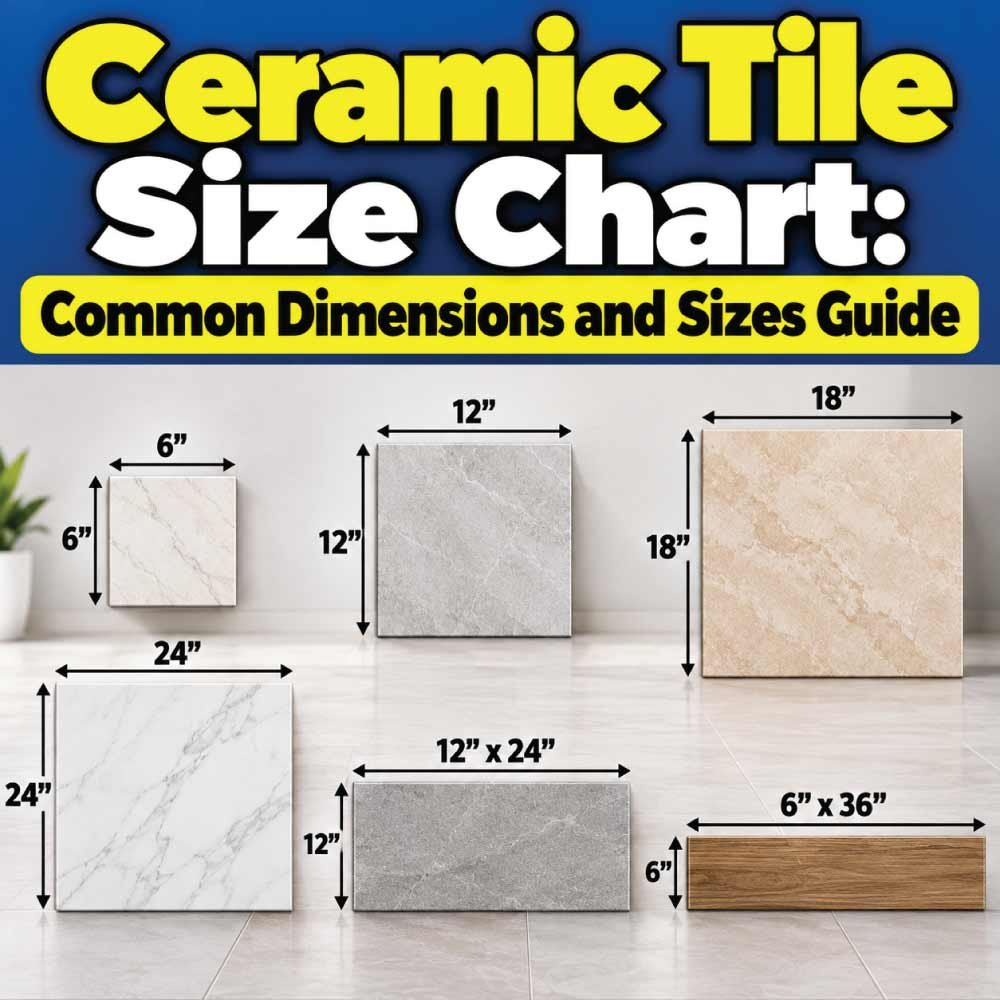
Choosing the right ceramic tile size can change the appearance, installation pattern, and practicality of a floor, wall, backsplash, bathroom, or other tiled surface. Ceramic tiles are available in many dimensions, from small square tiles used for detailed layouts to large rectangular tiles designed to create a more continuous look. Understanding common ceramic tile sizes makes it easier to compare options and estimate how a particular format will work in your space.
A ceramic tile size chart is especially useful when planning a project because tile dimensions are often described by nominal measurements such as 12 × 12 inches or 12 × 24 inches. The actual tile can be slightly different because of manufacturing tolerances, sizing methods, grout joints, and the way the tile is produced. This guide explains common ceramic tile dimensions, popular square and rectangular formats, how tile sizes affect a room, and what to consider before choosing a size.
Understanding Ceramic Tile Sizes and Dimensions
Ceramic tile sizes are usually given as width × length. For example, a 12 × 12-inch tile is approximately 12 inches wide and 12 inches long, while a 12 × 24-inch tile is twice as long as it is wide.
Tile size does more than determine how many pieces are needed. It also affects the number of grout joints, the visual scale of the finished surface, cutting requirements, installation difficulty, and the overall pattern.
Common ceramic tile measurements include:
- 3 × 6 inches
- 4 × 4 inches
- 6 × 6 inches
- 8 × 8 inches
- 12 × 12 inches
- 12 × 24 inches
- 16 × 16 inches
- 18 × 18 inches
- 24 × 24 inches
- 24 × 48 inches
Not every manufacturer produces every size. Availability can also vary according to the tile collection, finish, thickness, intended application, and region.
Nominal Size vs. Actual Tile Size
One of the most important things to understand is that the stated tile size is not always the exact physical measurement.
A tile marketed as 12 × 12 inches may have a slightly different actual dimension. This can happen because of manufacturing processes and because some tile products are intentionally produced to work with a particular grout joint.
For planning purposes, always check the manufacturer’s stated actual dimensions when they are available rather than assuming the nominal size is exact.
This distinction becomes particularly important when:
- Calculating the number of tiles required
- Planning a detailed pattern
- Aligning tiles with cabinets or fixtures
- Working around door openings
- Designing borders
- Matching an existing installation
- Determining grout-joint spacing
Ceramic Tile Size Chart
The following chart shows common ceramic tile dimensions and the applications where these formats are frequently considered.
| Ceramic Tile Size | Approximate Format | Common Applications | Typical Visual Effect |
|---|---|---|---|
| 3 × 6 in. | Small rectangular | Backsplashes, walls, showers | Detailed, traditional |
| 4 × 4 in. | Small square | Walls, backsplashes, bathrooms | Classic, grid-like |
| 6 × 6 in. | Small square | Walls, floors, bathrooms | Traditional and balanced |
| 8 × 8 in. | Medium square | Floors and walls | Moderate visual scale |
| 12 × 12 in. | Standard square | Floors and walls | Balanced and versatile |
| 12 × 24 in. | Medium rectangular | Floors, walls, bathrooms | Longer, more spacious appearance |
| 16 × 16 in. | Large square | Floors and larger rooms | Fewer grout lines |
| 18 × 18 in. | Large square | Floors and open areas | Broad, clean appearance |
| 24 × 24 in. | Extra-large square | Large floors and open spaces | Minimal visual interruption |
| 24 × 48 in. | Large rectangular | Large walls and floors | Continuous, modern appearance |
These are common formats rather than a universal standard. Ceramic tile collections may include additional dimensions, and some products are designed around unusual proportions or decorative patterns.
Common Ceramic Tile Sizes for Different Projects
The best ceramic tile size depends heavily on where the tile will be installed. A small wall backsplash and a large open floor do not necessarily benefit from the same format.
3 × 6 Inch Ceramic Tiles
The 3 × 6-inch format is a small rectangular tile commonly associated with traditional wall layouts. Its proportions make it suitable for patterns such as running bond, stacked arrangements, and other decorative installations.
This size is often considered for:
- Kitchen backsplashes
- Bathroom walls
- Shower walls
- Decorative wall areas
- Small accent sections
Because the individual pieces are relatively small, there are more grout joints across a given surface.
4 × 4 Inch Ceramic Tiles
A 4 × 4-inch square is another traditional ceramic tile format. It can create a strong grid pattern and works particularly well where smaller tile dimensions are desirable.
It is commonly used for walls, backsplashes, bathroom areas, and decorative installations.
Smaller square tiles can also make it easier to accommodate changes in wall dimensions and work around small fixtures compared with very large tiles.
6 × 6 Inch Ceramic Tiles
Six-inch square tiles offer a middle ground between small decorative formats and larger field tiles.
They can be used on walls and floors depending on the particular product. Their moderate dimensions provide more grout joints than larger tiles while still covering a reasonable amount of surface with each piece.
8 × 8 Inch Ceramic Tiles
An 8 × 8-inch tile provides a larger visual scale than traditional 4 × 4 or 6 × 6 formats without becoming as visually expansive as a large-format tile.
This size can work well in bathrooms, kitchens, utility spaces, and other areas where a medium-sized square tile is appropriate.
12 × 12 Inch Ceramic Tile Size
The 12 × 12-inch ceramic tile has long been a familiar format for residential tile installations.
Its relatively balanced proportions make it versatile, and it can be arranged in a straightforward grid or combined with other sizes to create patterns.
A 12 × 12-inch tile may be considered for:
- Kitchen floors
- Bathroom floors
- Entry areas
- Utility rooms
- Interior walls
- Decorative layouts
One advantage of this size is its flexibility. It is large enough to reduce the number of individual pieces compared with small tiles, while remaining manageable for many conventional installations.
However, whether it is appropriate for a particular floor depends on the actual ceramic tile product and its stated application.
12 × 24 Inch Ceramic Tile Size
The 12 × 24-inch format is a popular rectangular dimension because it creates a noticeably different visual effect from square tile.
Its elongated shape can emphasize the direction in which the tile is installed. For example, laying rectangular tiles along the length of a room can visually reinforce that direction.
This format is often considered for:
- Bathroom floors
- Kitchen floors
- Large wall areas
- Shower walls
- Entryways
- Open-plan spaces
The layout can be installed in several patterns, including offset and stacked arrangements.
Large rectangular tiles also require careful planning because wall or floor irregularities can become more noticeable when longer pieces are used.
Large Ceramic Tile Sizes
Large-format ceramic tiles are increasingly available in dimensions considerably larger than traditional field tiles. Examples include 16 × 16, 18 × 18, 24 × 24, and rectangular formats such as 24 × 48 inches.
The exact definition of “large format” can vary by product and industry context, so it is better to consider the actual dimensions and installation requirements rather than relying solely on the label.
16 × 16 and 18 × 18 Inch Tiles
These larger square formats can create a more open appearance because fewer individual tiles are visible across the same surface.
They can be useful in:
- Large bathrooms
- Open living areas
- Kitchens
- Hallways
- Commercial-style interiors
The larger the tile, the more important substrate preparation becomes. A surface that is not sufficiently flat can create installation problems with larger pieces.
24 × 24 Inch Tiles
A 24 × 24-inch tile provides a broad, uninterrupted appearance and can work especially well in larger rooms.
Because each piece covers approximately four square feet before accounting for joints and actual dimensions, fewer tiles are needed to cover a given area than with smaller formats.
However, the size also means each tile can be more difficult to handle, position, and cut. The installation method must suit the specific product.
24 × 48 Inch Tiles
A 24 × 48-inch format creates a long, dramatic surface with relatively few grout lines. It can be considered for large walls and floors where the installation system and product specifications permit it.
Large rectangular tiles require particularly careful planning around corners, openings, fixtures, and room transitions. Their dimensions can make even small layout mistakes more noticeable.
How Ceramic Tile Size Affects a Room
Tile dimensions can influence how a room looks without changing the actual physical size of the space.
Small Tiles and Grout Lines
Small ceramic tiles create more joints over a given area. The resulting grid can add visual detail and definition.
This can be useful when a decorative appearance is desired or when the installation contains many small areas and obstacles.
The downside is that more grout joints also mean more grout lines to clean and maintain.
Large Tiles and Fewer Joints
Larger tiles generally create fewer visible grout joints.
This can make a surface appear more continuous, particularly when the grout color is close to the tile color. Large formats can also provide a clean, contemporary appearance.
However, large tiles do not automatically make every small room look larger. The final effect depends on tile color, grout width, layout direction, lighting, room proportions, and the number of cuts.
Ceramic Tile Size by Application
Different areas of a home often call for different tile formats.
| Application | Common Tile Formats to Consider |
|---|---|
| Kitchen backsplash | 3 × 6, 4 × 4, 6 × 6, rectangular formats |
| Bathroom wall | 3 × 6, 4 × 4, 6 × 6, 12 × 24 |
| Bathroom floor | 6 × 6, 8 × 8, 12 × 12, larger formats |
| Kitchen floor | 8 × 8, 12 × 12, 12 × 24, larger formats |
| Shower wall | Small rectangles, squares, 12 × 24 and other suitable formats |
| Entry floor | 12 × 12, 12 × 24, 16 × 16 and larger |
| Large open floor | 12 × 24, 18 × 18, 24 × 24 and larger formats |
| Decorative accent | Small squares, rectangles, mosaics and specialty formats |
This chart should be treated as a planning reference rather than a rule. The suitability of a particular ceramic tile depends on the product’s intended use and installation requirements.
How to Choose the Right Ceramic Tile Size
Selecting a tile size involves more than choosing the appearance you prefer. Measure the space first and then consider the practical conditions of the installation.
Measure the Installation Area
Measure the length and width of the area and calculate the total square footage.
For a rectangular surface:
Area = Length × Width
For irregular rooms, divide the surface into simpler rectangles, calculate each area separately, and add the results.
Remember that tile coverage should be based on the actual dimensions and installation layout rather than relying only on the nominal tile size.
Consider the Room Size
Large tiles can work effectively in large rooms because their proportions complement the open area.
Smaller tiles may be easier to incorporate into compact or highly detailed spaces, particularly where numerous cuts and changes in direction are unavoidable.
That does not mean small rooms cannot use large tiles. With an appropriate layout, large-format tiles can also work in compact areas.
Think About Grout Lines
Grout spacing affects the final appearance.
A small tile installation can have a stronger grid effect, while larger tiles generally produce fewer interruptions. The appropriate joint width depends on the tile, installation requirements, tile variation, and desired appearance.
Do not choose a grout-joint width solely for appearance if it conflicts with the tile manufacturer’s installation recommendations.
Plan Around Fixtures and Openings
Doors, cabinets, drains, plumbing fixtures, corners, niches, and other obstacles all affect tile layout.
A large tile may look excellent in an open section but require awkward cuts around multiple fixtures. Smaller formats can sometimes provide more flexibility.
A good layout aims to avoid extremely narrow pieces along important edges whenever possible.
Also Read:
Ceramic Tile Size and Installation Considerations
Tile size has a direct relationship with installation difficulty.
Large tiles require a suitably prepared substrate because uneven surfaces can create problems across the length or width of the tile. The larger the tile, the more apparent surface irregularities can become.
Handling is another consideration. A large ceramic tile can be heavier, harder to position, and more difficult to cut than a small tile.
Before installation, check:
- The tile’s intended application
- Recommended substrate conditions
- Installation method
- Grout-joint requirements
- Required cutting equipment
- Surface flatness requirements
- Tile thickness and actual dimensions
- Room layout and transition points
For complicated installations, planning the layout before setting the first tile can prevent unnecessary cuts and wasted material.
Also Read:
How Many Ceramic Tiles Do You Need?
The number of tiles depends on the surface area and the actual coverage provided by each tile.
For a simple rectangular room, calculate the floor area first. Then determine the coverage of one tile.
For example, a nominal 12 × 12-inch tile covers approximately one square foot before accounting for the actual manufactured dimensions and grout joints.
A nominal 12 × 24-inch tile covers approximately two square feet under the same simplified calculation.
You should then account for cutting and waste. The amount of additional material required depends on the room shape, tile size, pattern, number of obstacles, and installation complexity.
Do not assume that buying exactly the calculated area will always be sufficient. A project with many cuts generally requires more allowance than a simple open rectangle.
Common Ceramic Tile Layout Patterns
The same tile size can produce very different results depending on its layout.
Straight Grid
Tiles are aligned in regular rows and columns. This arrangement works particularly well with square tiles and produces a clean, orderly appearance.
Running Bond
Each row is offset from the row before it. This is commonly associated with rectangular tiles and can emphasize the length of the tile.
Stacked Layout
Tiles are aligned directly above and beside one another. This produces strong vertical and horizontal lines and can give rectangular tiles a more contemporary appearance.
Diagonal Layout
Square tiles can be positioned at an angle to create a diagonal pattern. This increases cutting requirements but creates a different visual direction.
The best layout depends on the room dimensions, tile format, desired appearance, and practical installation requirements.
Also Read:
Common Mistakes When Choosing Ceramic Tile Size
Several avoidable mistakes can complicate a tile project.
Choosing Based Only on Appearance
A tile may look attractive in a sample but behave differently once installed across a large area. Consider the room dimensions, substrate, grout joints, maintenance, and cutting requirements as well.
Ignoring Actual Dimensions
Do not assume the advertised nominal size is the exact physical size. Actual measurements matter when planning tight layouts.
Using a Large Tile on an Unsuitable Surface
Large tiles are less forgiving of uneven substrates. Surface preparation should be addressed before installation begins.
Forgetting Waste and Cuts
A room rarely consists of a perfect grid of whole tiles. Corners, walls, fixtures, doors, and other features create cuts.
Failing to Plan the Layout
Starting at the first available wall without planning can result in narrow slivers at the opposite side of the room.
A dry layout or carefully measured starting point can help produce a more balanced result.
Ceramic Tile Sizes vs. Porcelain Tile Sizes
Ceramic and porcelain tiles can share many of the same nominal formats, including squares and rectangles ranging from small decorative pieces to large-format tiles.
The key difference is not necessarily the dimensions. Tile size is a separate characteristic from the tile’s material classification.
When comparing ceramic and porcelain products, consider:
- Actual dimensions
- Intended application
- Thickness
- Surface finish
- Water absorption characteristics
- Installation requirements
- Weight
- Available formats
Two tiles with the same nominal dimensions can have different technical characteristics, so size alone should not determine which product is appropriate.
Frequently Asked Questions
What is the most common ceramic tile size?
12 × 12 inches is a familiar and widely used ceramic tile format, although many other dimensions are common. The most appropriate size depends on the application and product.
What are common ceramic tile sizes for bathrooms?
Common bathroom formats include 4 × 4, 6 × 6, 8 × 8, 12 × 12, and 12 × 24 inches. Wall and floor requirements can differ, so the product’s intended application should always be checked.
Is 12 × 24 tile considered large?
A 12 × 24-inch tile is substantially larger than traditional small square formats and is commonly considered a larger-format rectangular tile. Exact terminology can vary.
What ceramic tile size is best for a small bathroom?
There is no single best size for every small bathroom. Small and medium tiles can work well around fixtures and tight areas, while larger tiles can reduce grout lines and create a more continuous appearance.
Are ceramic tile dimensions exact?
Not necessarily. Nominal dimensions may differ slightly from actual manufactured dimensions. Always verify the actual size when precise layout calculations are necessary.
Does tile size affect grout quantity?
Yes. Smaller tiles generally create more grout joints across the same surface, while larger tiles usually create fewer joints. Joint width also affects the amount of grout required.
Can large ceramic tiles be used on walls?
Some large ceramic tiles are designed for wall applications, but suitability depends on the specific product, weight, substrate, and installation requirements.
How much extra ceramic tile should I buy?
The required allowance depends on the room shape, tile dimensions, layout pattern, and number of cuts. A simple rectangular installation generally has fewer cutting challenges than a complex layout with many corners and fixtures.
Can different ceramic tile sizes be combined?
Yes. Different sizes can be combined to create patterns, borders, accents, or coordinated layouts. The actual dimensions and grout-joint requirements should be considered before combining formats.
Conclusion
A ceramic tile size chart is a useful starting point for understanding the dimensions available for floors, walls, backsplashes, bathrooms, kitchens, and other applications. Common formats range from small 3 × 6-inch and 4 × 4-inch tiles to larger 12 × 24, 18 × 18, 24 × 24, and other large rectangular formats.
The right choice depends on more than the tile’s dimensions. Room size, layout, grout joints, actual tile measurements, substrate condition, cutting requirements, and intended application all matter. Small tiles can provide detail and flexibility, while larger tiles can create fewer grout lines and a more continuous appearance.
Before purchasing, compare the nominal and actual dimensions, calculate the surface area, plan the layout, and verify that the selected ceramic tile is appropriate for the intended installation. With those details established first, choosing a ceramic tile size becomes a much more straightforward process.