
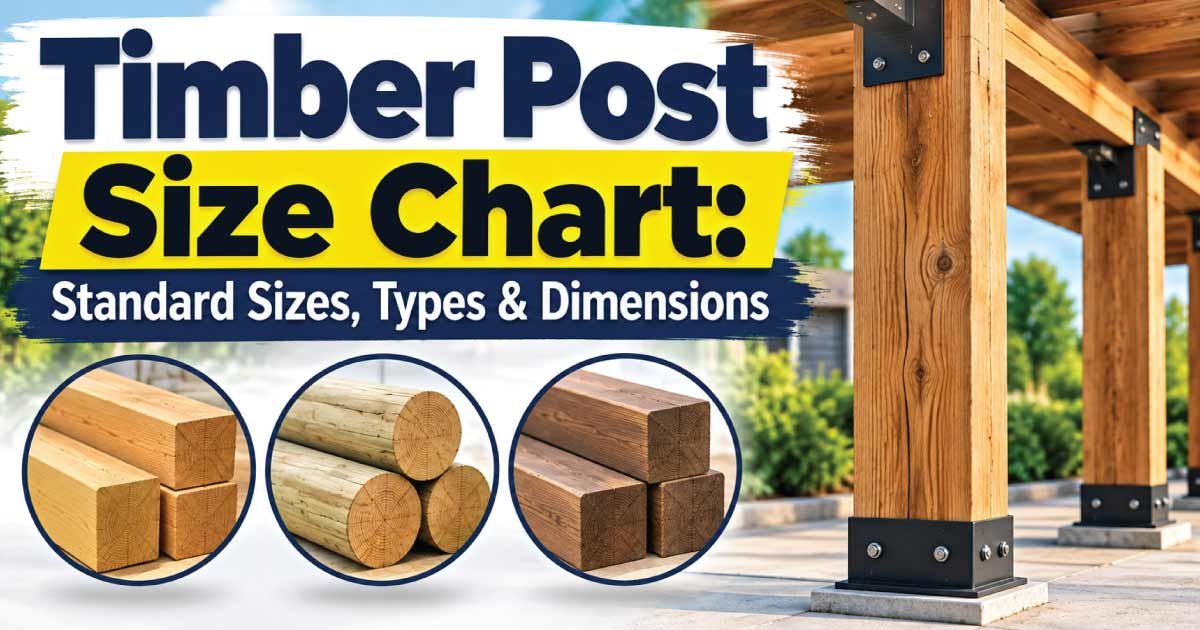
Timber posts are widely used in construction, landscaping, fencing, decks, pergolas, agricultural structures, and other outdoor projects. Choosing the right timber post size is important because the dimensions of a post can affect strength, stability, appearance, durability, and overall project performance.
A timber post size chart makes it easier to compare common post dimensions and understand how different sizes are used. Timber posts are commonly available in square or rectangular dimensions, with sizes selected according to the structural load, post height, spacing, installation method, wood species, and intended application.
One important detail is that nominal timber dimensions are not always the same as actual dimensions. A post sold as a nominal 4 × 4, for example, may measure slightly smaller after drying and machining. This difference matters when calculating clearances, fitting posts into brackets, or designing connections.
This guide explains common timber post sizes, standard dimensions, timber post types, nominal versus actual sizes, typical applications, post spacing, installation considerations, and factors to consider when selecting a suitable timber post.
What Is a Timber Post?
A timber post is a vertical structural or supporting member made from wood. It can be manufactured from solid sawn timber, treated lumber, engineered wood, or other wood-based materials.
Timber posts are commonly installed vertically to transfer loads toward the ground or foundation. Depending on the project, a post may support a roof, beam, deck, fence, railing, pergola, gate, or other structure.
Common timber post applications include:
- Deck support posts
- Fence posts
- Pergola posts
- Porch posts
- Gate posts
- Roof-support posts
- Agricultural posts
- Landscaping posts
- Retaining structures
- Timber-framed structures
- Decorative architectural posts
The required post size depends heavily on the purpose of the post. A small fence post does not normally require the same dimensions as a structural post supporting a heavy beam.
Why Timber Post Size Matters
The size of a timber post influences its ability to resist different types of forces. Larger posts generally provide greater cross-sectional area and can offer increased resistance to bending, compression, and other structural demands.
However, simply choosing the largest available post is not always the best solution.
The correct size should consider:
- Applied load
- Post height
- Post spacing
- Wood species
- Timber grade
- Moisture exposure
- Connection method
- Foundation design
- Wind loads
- Soil conditions
- Local building requirements
For structural projects, post sizing should be verified using appropriate structural calculations rather than relying only on a general size chart.
Timber Post Size Chart
The following chart shows common nominal timber post dimensions and their approximate actual dimensions. Exact actual dimensions can vary according to the timber product, manufacturing process, treatment, and supplier.
| Nominal Size | Approx. Actual Size | Common Uses |
|---|---|---|
| 3 × 3 | 2½ × 2½ in | Light fencing, garden structures |
| 4 × 4 | 3½ × 3½ in | Fences, decks, pergolas |
| 4 × 6 | 3½ × 5½ in | Beams, heavier supports |
| 5 × 5 | About 4½ × 4½ in | Posts, landscaping |
| 6 × 6 | 5½ × 5½ in | Decks, pergolas, structural supports |
| 6 × 8 | 5½ × 7½ in | Heavy structural applications |
| 8 × 8 | 7½ × 7½ in | Large structural supports |
| 8 × 10 | 7½ × 9½ in | Heavy timber construction |
| 10 × 10 | About 9½ × 9½ in | Large timber structures |
These dimensions are useful for general comparison, but the actual product should always be measured before designing brackets, joints, or openings.
Nominal vs Actual Timber Post Sizes
One of the most important concepts when purchasing timber posts is the difference between nominal and actual dimensions.
What Is a Nominal Timber Size?
A nominal size is the traditional dimension used to identify lumber before processing. It is commonly used when timber is sold or specified.
For example, a timber post may be described as a 4 × 4 post even though its finished dimensions are smaller.
What Is the Actual Timber Size?
The actual size is the physical measurement of the finished timber.
For example, a nominal 4 × 4 timber may have an actual dimension close to:
3½ × 3½ inches
The difference occurs because the timber is processed, surfaced, dried, or otherwise finished.
Why the Difference Matters
Understanding actual dimensions is especially important when:
- Installing post brackets
- Building timber joints
- Cutting notches
- Setting post spacing
- Creating concrete forms
- Designing connections
- Calculating clearances
Always check the manufacturer’s specifications for the exact product.
Common Timber Post Sizes
Timber posts are available in many dimensions, but some sizes are considerably more common than others.
3 × 3 Timber Posts
3 × 3 posts are generally suited to lighter applications where large structural loads are not expected.
They may be used for:
- Garden structures
- Lightweight fencing
- Decorative supports
- Small outdoor projects
They are generally less suitable for heavily loaded structural applications.
4 × 4 Timber Posts
4 × 4 posts are among the most commonly recognized timber post sizes.
They are often used for:
- Fence posts
- Deck posts
- Pergola supports
- Garden structures
- Small gates
Their popularity comes from their balance of availability, strength, cost, and ease of installation.
6 × 6 Timber Posts
6 × 6 posts provide a substantially larger cross-section than 4 × 4 posts.
They are commonly considered when greater capacity, stiffness, or visual presence is required.
Typical uses include:
- Deck support posts
- Large pergolas
- Porches
- Heavy beams
- Timber structures
8 × 8 Timber Posts
8 × 8 posts are much larger and are generally associated with heavier timber construction.
They may be used for:
- Large timber frames
- Heavy structural supports
- Agricultural structures
- Large covered outdoor structures
Their final suitability depends on engineering requirements rather than size alone.
Timber Post Dimensions in Inches and Millimeters
Timber is commonly specified in inches in some markets and millimeters in others. Converting between systems helps when comparing products.
| Nominal Size | Nominal Dimensions in mm | Approx. Actual Dimensions |
|---|---|---|
| 3 × 3 in | 76 × 76 mm | 64 × 64 mm |
| 4 × 4 in | 102 × 102 mm | 89 × 89 mm |
| 4 × 6 in | 102 × 152 mm | 89 × 140 mm |
| 6 × 6 in | 152 × 152 mm | 140 × 140 mm |
| 6 × 8 in | 152 × 203 mm | 140 × 191 mm |
| 8 × 8 in | 203 × 203 mm | 191 × 191 mm |
| 8 × 10 in | 203 × 254 mm | 191 × 241 mm |
| 10 × 10 in | 254 × 254 mm | 241 × 241 mm |
The millimeter values are approximate conversions. Actual finished timber dimensions can vary by product and supplier.
Types of Timber Posts
Timber posts can be classified according to wood type, treatment, manufacturing method, and intended use.
Pressure-Treated Timber Posts
Pressure-treated timber is commonly used outdoors because treatment can improve resistance to decay, insects, and moisture-related deterioration.
Common applications include:
- Decks
- Fences
- Pergolas
- Outdoor structures
- Landscaping
Treatment does not mean a timber post can be installed without considering drainage and moisture exposure. Proper installation remains important.
Untreated Timber Posts
Untreated timber can be appropriate for interior or protected applications.
It may be used where the timber remains away from prolonged moisture exposure or where additional protective measures are provided.
Hardwood Timber Posts
Hardwood posts can provide durability, strength, and a distinctive appearance. Depending on the species, they may be used for premium outdoor structures, landscaping, gates, and architectural applications.
Softwood Timber Posts
Softwood is widely used because it is generally easy to work with and can be available in a variety of dimensions.
Common softwood posts are often manufactured from species such as pine, fir, or spruce, depending on the market.
Engineered Timber Posts
Engineered wood products can provide more consistent dimensions and performance than some solid-sawn products.
They may be selected for specific structural applications where engineered properties are required.
Timber Post Size for Fences
Fence posts generally have different requirements from structural building posts.
A fence post must resist the weight of the fence as well as forces such as wind and impact.
Common fence post sizes include:
| Fence Type | Common Post Size Range | Important Considerations |
|---|---|---|
| Light garden fence | 3 × 3 to 4 × 4 | Low height and light panels |
| Privacy fence | 4 × 4 or larger | Height and wind exposure |
| Heavy timber fence | 4 × 4 to 6 × 6 | Panel weight and spacing |
| Large gate | 6 × 6 or larger | Gate weight and movement |
These are general starting points rather than universal structural requirements.
For tall fences or areas with strong winds, larger posts and stronger foundations may be required.
Timber Post Size for Decks
Deck posts carry vertical loads from beams, joists, decking, people, furniture, and sometimes additional loads.
Because of this, deck post sizing should not be selected solely from appearance.
Commonly encountered deck post dimensions include:
- 4 × 4
- 6 × 6
- Larger timber sections for special applications
A deck post design should consider the tributary area supported by each post, beam configuration, post height, connections, and foundation.
For many modern deck designs, 6 × 6 posts may provide advantages over smaller posts, but the correct size depends on the specific structural design and applicable code.
Timber Post Size for Pergolas
Pergolas often use larger timber posts because the posts are highly visible and need to support beams and roof-like members.
Common decorative and structural pergola post sizes include:
- 4 × 4
- 6 × 6
- 8 × 8
A 6 × 6 post can provide a substantial appearance while offering more cross-sectional area than a 4 × 4 post.
However, pergola design also needs to account for:
- Beam loads
- Roof or shade loads
- Wind
- Post height
- Footings
- Connections
- Lateral stability
Timber Post Size for Porches
Porch posts may support significant loads from beams and roof structures.
The required dimensions depend on the load path and overall building design.
A porch post should be evaluated according to:
- Roof load
- Beam size
- Post spacing
- Post height
- Wind exposure
- Connection details
- Foundation capacity
Decorative wrapping around a smaller structural post should not be confused with the actual load-bearing post.
How Timber Post Height Affects Size
Post height is an important factor when selecting timber dimensions.
A tall post can be more vulnerable to bending and buckling than a shorter post carrying the same vertical load.
For this reason, two posts with identical cross-sectional dimensions may perform differently when installed at different heights.
As post height increases, the design may require:
- Larger cross-sectional dimensions
- Better lateral bracing
- Reduced post spacing
- Stronger connections
- Improved foundations
Structural design should consider the complete load path rather than simply increasing post size.
Timber Post Spacing
Post spacing refers to the distance between adjacent posts.
The appropriate spacing depends on the structure being supported.
For example, a deck may require different spacing from a fence or pergola.
Factors affecting post spacing include:
- Beam span
- Joist arrangement
- Post dimensions
- Load requirements
- Material grade
- Foundation layout
- Structural design
Reducing the distance between posts can reduce the load carried by individual posts and supporting beams, but it can also increase material and foundation requirements.
Timber Post Load Capacity
There is no single load capacity for every timber post of a particular size.
For example, a 6 × 6 post can have different structural performance depending on:
- Timber species
- Grade
- Moisture condition
- Height
- Load direction
- Unsupported length
- Connection details
- End conditions
- Bracing
- Defects
- Environmental exposure
Therefore, a simple statement such as “a 6 × 6 post supports X pounds” can be misleading without complete design information.
For load-bearing structures, capacity should be determined using the applicable structural design method and verified by a qualified professional when required.
Timber Post Wood Species
The species of timber can significantly affect its properties.
Different species can have different:
- Strength characteristics
- Density
- Durability
- Workability
- Dimensional stability
- Treatment compatibility
- Cost
Softwood species are frequently used for general construction, while hardwoods may be selected for durability, appearance, or specific performance requirements.
The species should therefore be considered alongside timber grade rather than treating all timber posts of the same dimensions as identical.
Timber Post Grades
Timber grade describes the quality and structural characteristics of the wood.
Two posts with identical dimensions can have different structural properties if they have different grades.
Grade can be affected by characteristics such as:
- Knots
- Grain
- Checks
- Splits
- Density
- Defects
When a post is being used structurally, use timber that meets the required grade rather than selecting material based only on dimensions.
Timber Post Lengths
Timber posts are available in different lengths depending on the supplier and intended application.
Common lengths may include:
- 6 ft
- 8 ft
- 10 ft
- 12 ft
- 14 ft
- 16 ft
- Longer specialty lengths
The available lengths vary by timber type and market.
When selecting a post length, account for both the visible height and the portion installed into the foundation or ground.
Also Read:
Above-Ground vs In-Ground Timber Posts
Timber posts can be installed above ground using brackets or post bases, or they may extend into the ground depending on the project.
Above-Ground Posts
Above-ground posts are commonly installed on:
- Concrete footings
- Metal post bases
- Anchored brackets
- Structural connectors
Keeping the timber above standing water can help reduce moisture-related deterioration.
In-Ground Posts
Posts installed directly into soil experience greater moisture and biological exposure.
When this installation method is used, the timber should be appropriate for ground-contact conditions, and drainage and foundation design should be considered carefully.
How Deep Should a Timber Post Be Installed?
There is no single universal depth for every timber post.
Required depth can depend on:
- Post height
- Fence or structure type
- Soil conditions
- Wind exposure
- Frost conditions
- Foundation design
- Local requirements
For a simple fence, installation depth may be substantially different from the foundation requirements for a structural deck or building post.
The foundation should be designed according to the project’s structural and site requirements.
Timber Post Footings
A timber post foundation transfers loads into the ground.
Depending on the project, a footing may consist of:
- Concrete pier
- Concrete pad
- Ground anchor
- Post base
- Reinforced foundation
- Other engineered support
A suitable footing needs enough capacity to resist vertical and lateral loads.
Poorly designed footings can cause:
- Post movement
- Settlement
- Leaning
- Rotation
- Structural instability
Therefore, choosing the correct timber post is only one part of a complete support system.
Also Read:
Timber Post Connections
The connection between a post and beam can be just as important as the post itself.
Common connection methods include:
- Bolts
- Structural screws
- Post caps
- Metal brackets
- Beam hangers
- Plates
- Notched connections
Connections should be selected according to the loads they need to transfer.
A strong timber post with an inadequate connection can still create a weak structural point.
How to Measure a Timber Post
Measuring a timber post is straightforward.
Step 1: Measure the Width
Place a tape measure across one side of the post.
Step 2: Measure the Depth
Measure across the adjacent side.
For a square post, both measurements should be similar.
Step 3: Measure the Length
Measure from one end to the other.
Step 4: Record Actual Dimensions
Write down the physical measurements rather than relying only on the nominal label.
For example:
Nominal: 4 × 4 × 8 ft
Approximate actual cross-section: 3½ × 3½ inches
This approach is particularly useful when ordering brackets or replacement timber.
How to Choose the Right Timber Post Size
Selecting a timber post should begin with the intended application.
For Fences
Consider:
- Fence height
- Panel weight
- Wind exposure
- Post spacing
- Gate loads
- Soil conditions
For Decks
Consider:
- Deck dimensions
- Tributary load
- Beam span
- Post spacing
- Post height
- Foundation design
For Pergolas
Consider:
- Beam dimensions
- Roof or shade loads
- Post height
- Wind
- Aesthetic requirements
- Foundation and connections
For Structural Buildings
Structural timber posts should be sized through an appropriate engineering or building-code-based design process.
Timber Post Size Comparison
The following comparison helps show how common post sizes differ in cross-sectional area.
| Nominal Post | Nominal Cross-Sectional Area | Relative Size |
|---|---|---|
| 3 × 3 | 9 sq in | Small |
| 4 × 4 | 16 sq in | Medium |
| 4 × 6 | 24 sq in | Medium-Large |
| 6 × 6 | 36 sq in | Large |
| 6 × 8 | 48 sq in | Very Large |
| 8 × 8 | 64 sq in | Extra Large |
| 8 × 10 | 80 sq in | Extra Large |
| 10 × 10 | 100 sq in | Heavy Timber |
Cross-sectional area is only one factor in structural performance. It should not be interpreted as a direct load-capacity rating.
Common Timber Post Problems
Even correctly sized timber posts can experience problems if they are improperly selected or installed.
Common problems include:
- Rot
- Splitting
- Excessive checking
- Insect damage
- Moisture deterioration
- Post movement
- Leaning
- Poor connections
- Insufficient foundations
Regular inspection is particularly useful for outdoor timber structures.
Look for changes in:
- Post alignment
- Surface condition
- Connection tightness
- Ground contact
- Cracks and splits
- Signs of decay
Common Timber Post Selection Mistakes
Several mistakes can reduce the performance of a timber post system.
Choosing Only by Size
A larger dimension does not automatically mean a post is suitable. Species, grade, height, connections, and loads also matter.
Ignoring Actual Dimensions
Brackets and connectors are designed around physical dimensions. Always verify actual timber measurements.
Using Indoor Timber Outdoors
Untreated timber may deteriorate quickly when exposed to moisture and ground conditions.
Ignoring Wind Loads
Fences, pergolas, and other outdoor structures can experience substantial lateral forces from wind.
Underestimating Foundation Requirements
A strong post cannot compensate for an inadequate foundation.
Using Damaged Timber
Severe splits, decay, insect damage, or other defects can compromise performance.
Timber Post Installation Tips
Proper installation helps improve the durability and stability of timber posts.
Useful practices include:
- Keep posts properly aligned.
- Use suitable structural connectors.
- Prevent unnecessary water accumulation around the post.
- Use ground-contact-rated timber where required.
- Provide adequate foundation support.
- Protect cut ends when recommended for treated timber.
- Avoid trapping moisture around the base.
- Check posts for movement after installation.
- Follow the applicable construction requirements.
For structural work, installation should follow the project’s engineered details or approved construction specifications.
Timber Post Cost Factors
Timber post cost varies considerably according to dimensions and material.
Larger posts generally require more timber, which can increase material cost.
Other factors include:
- Timber species
- Grade
- Treatment
- Length
- Availability
- Surface finish
- Local market prices
A 6 × 6 post will normally require more material than a 4 × 4 post, while specialty hardwood or engineered timber can cost considerably more than standard construction-grade softwood.
When estimating project costs, remember to include:
- Timber
- Post bases
- Fasteners
- Concrete
- Brackets
- Labor
- Finishing materials
- Protective treatments
Timber Post Size Chart by Application
| Application | Common Timber Post Sizes | Main Considerations |
|---|---|---|
| Garden fence | 3 × 3 to 4 × 4 | Fence height and weight |
| Privacy fence | 4 × 4 to 6 × 6 | Wind and panel weight |
| Deck | 4 × 4 to 6 × 6+ | Loads and post height |
| Pergola | 4 × 4 to 8 × 8 | Beam loads and wind |
| Porch | 6 × 6+ | Roof and beam loads |
| Heavy timber structure | 6 × 6 to 10 × 10+ | Engineering required |
| Decorative post | Varies | Appearance and dimensions |
These ranges are general examples, not universal structural requirements.
Timber Post Size FAQs
What is the most common timber post size?
The 4 × 4 timber post is one of the most common sizes for general outdoor applications such as fences, small structures, and some deck designs. Larger structural applications may require 6 × 6 or larger posts.
Is a 6 × 6 timber post stronger than a 4 × 4?
A 6 × 6 post has a substantially larger cross-sectional area than a 4 × 4 post. However, actual structural capacity also depends on species, grade, height, bracing, loads, connections, and installation conditions.
What is the actual size of a 4 × 4 timber post?
A commonly surfaced nominal 4 × 4 timber post may measure approximately 3½ × 3½ inches. Always check the manufacturer’s actual dimensions.
What size timber post is best for a pergola?
4 × 4, 6 × 6, and larger posts can all be used depending on the pergola’s dimensions and structural requirements. A 6 × 6 is often considered when a larger structural section and stronger visual appearance are desired.
What size timber post is best for a fence?
The appropriate fence post size depends on fence height, panel weight, post spacing, wind exposure, and soil conditions. 4 × 4 is a common starting point for many applications, while larger posts may be appropriate for taller or heavier fences.
Are timber post sizes nominal or actual?
Timber posts are commonly identified by nominal dimensions, while their finished physical dimensions are usually smaller. Always verify actual dimensions before purchasing connectors or designing joints.
Can timber posts be used outdoors?
Yes. Timber posts are widely used outdoors, but the timber should be appropriate for the exposure conditions. Ground-contact applications generally require suitable treatment, durability, drainage, and foundation design.
How long do timber posts last?
Service life depends on timber species, treatment, moisture exposure, installation, soil conditions, maintenance, and climate. Proper drainage and suitable material selection can significantly improve durability.
Should timber posts be set directly in concrete?
The appropriate installation method depends on the project. In some cases, posts are attached to concrete foundations using metal post bases to reduce direct moisture exposure. The foundation and connection should be designed for the intended loads.
Final Thoughts
A timber post size chart is a useful starting point for comparing common dimensions, but post selection involves much more than simply choosing a larger or smaller piece of wood. Timber species, grade, post height, spacing, load, connections, foundation conditions, moisture exposure, and local requirements all influence the appropriate choice.
Common sizes such as 4 × 4, 6 × 6, 8 × 8, and larger timber posts can serve different purposes, from fencing and landscaping to decks, pergolas, porches, and heavy timber construction.
Remember that nominal dimensions may differ from actual finished measurements. Always verify the physical size of the timber before purchasing connectors or designing detailed joints.
For non-structural projects, a general size chart can help narrow down suitable options. For load-bearing structures, however, the final timber post size should be verified through appropriate structural calculations and applicable building requirements.