
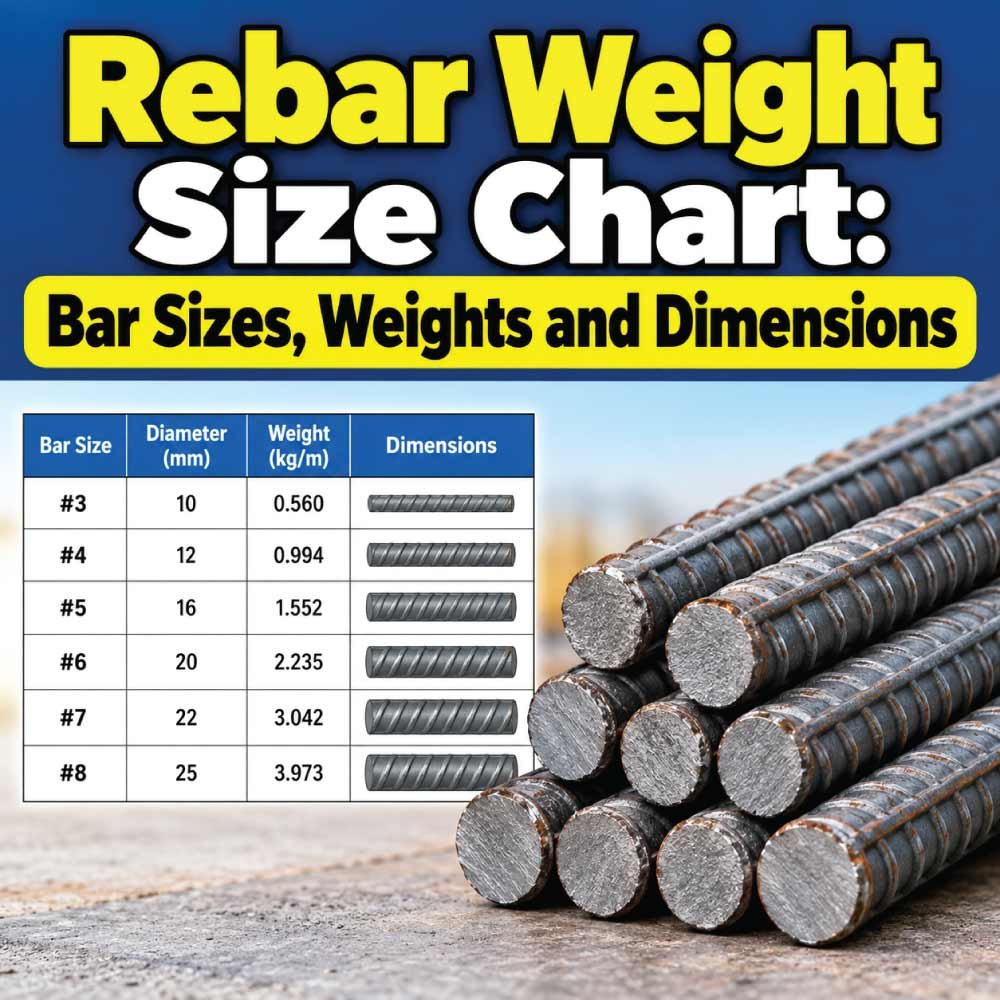
Rebar weight is an important consideration when estimating concrete reinforcement, planning material purchases, calculating transport loads, and preparing project quantities. Although reinforcing bars may look similar at a glance, their weight changes significantly with diameter, bar size, and length. A small difference in bar diameter can make a noticeable difference in the total weight of a large reinforcement order.
This rebar weight size chart guide explains common reinforcing bar sizes, nominal diameters, approximate weight per foot, weight per meter, and practical ways to calculate the total weight of rebar. It also explains the difference between U.S. bar numbers and metric bar sizes, how bar length affects total weight, and what to check before using a weight figure for estimating or structural work.
The values in the chart are theoretical nominal weights based on the bar dimensions. Actual supplied weights can vary within applicable manufacturing tolerances, so project-specific material documentation should be used when exact shipment weight is required.
What Is a Rebar Weight Size Chart?
A rebar weight size chart is a reference table that shows how much reinforcing steel weighs for different bar sizes. Depending on the chart, the information may be listed as pounds per foot, pounds per meter, kilograms per meter, or total weight for a standard bar length.
Rebar is generally identified by its nominal size rather than simply by its weight. In the U.S. system, reinforcing bars are commonly designated with numbers such as #3, #4, #5, and #6. The number corresponds to the nominal bar size in eighths of an inch. For example, a #4 bar has a nominal diameter of 4/8 inch, or 1/2 inch.
Metric reinforcing bars are normally identified by their nominal diameter in millimeters. A 10 mm bar, for example, is designated according to its nominal 10 mm diameter.
Because the cross-sectional area of a round bar increases with the square of its diameter, larger rebar becomes substantially heavier rather than increasing in weight by the same simple proportion as diameter.
Why Rebar Weight Matters in Construction
Knowing the weight of reinforcement helps with much more than purchasing steel. It can affect several parts of a construction project.
Material quantity estimating
Contractors and estimators often need to convert reinforcement schedules into approximate steel tonnage. If a project requires thousands of feet or meters of rebar, the weight per unit length provides a practical way to calculate the total quantity.
Transportation and handling
A bundle of reinforcing bars can become extremely heavy. Estimating its weight helps with transportation planning, unloading, storage, and lifting arrangements.
Cost estimation
Rebar is commonly purchased based on weight or tonnage. Calculating the approximate weight from bar size and length gives an estimator a way to develop material quantities before receiving a supplier’s final invoice.
Fabrication planning
Rebar may be cut, bent, shaped, and assembled before being placed in concrete. Knowing the original bar weight helps fabrication teams estimate material requirements and handling needs.
Structural documentation
Reinforcement drawings and schedules frequently identify bar sizes and lengths. Converting those dimensions into weight can make quantity takeoffs easier and can help identify unusually large or small material quantities.
Common Rebar Sizes and Their Approximate Weights
The following chart provides commonly used U.S. reinforcing bar sizes and their theoretical nominal weights. The figures are useful for estimating and quantity calculations.
| U.S. Rebar Size | Nominal Diameter | Approx. Weight per Foot | Approx. Weight per Meter |
|---|---|---|---|
| #3 | 3/8 in | 0.376 lb | 0.560 kg |
| #4 | 1/2 in | 0.668 lb | 0.994 kg |
| #5 | 5/8 in | 1.043 lb | 1.552 kg |
| #6 | 3/4 in | 1.502 lb | 2.235 kg |
| #7 | 7/8 in | 2.044 lb | 3.049 kg |
| #8 | 1 in | 2.670 lb | 3.973 kg |
| #9 | 1 1/8 in | 3.400 lb | 5.071 kg |
| #10 | 1 1/4 in | 4.303 lb | 6.404 kg |
| #11 | 1 3/8 in | 5.313 lb | 7.907 kg |
| #14 | 1 3/4 in | 7.650 lb | 11.400 kg |
| #18 | 2 1/4 in | 13.600 lb | 20.284 kg |
These are theoretical nominal values intended for estimating. They should not be interpreted as the guaranteed scale weight of every individual reinforcing bar.
One useful detail is the relationship between diameter and weight. A #8 bar is only twice the nominal diameter of a #4 bar, but its weight per foot is about four times as great. That happens because the area of a circular cross section depends on diameter squared.
How Rebar Size Affects Weight
The diameter of a reinforcing bar is the main factor determining its theoretical weight per unit length.
For a round steel bar, the cross-sectional area can be represented by:
Area = π × diameter² ÷ 4
Because weight is related to cross-sectional area, increasing the diameter produces a relatively large increase in weight.
For practical estimating, a commonly used metric relationship is:
Weight per meter ≈ diameter² ÷ 162
where diameter is expressed in millimeters and the resulting weight is approximately kilograms per meter.
For example, a 12 mm bar has an approximate theoretical weight of:
12² ÷ 162 = 0.889 kg/m
A 16 mm bar is approximately:
16² ÷ 162 = 1.580 kg/m
This illustrates why a modest increase in diameter can have a significant effect on total steel weight.
Rebar Weight per Foot and per Meter
Two of the most useful measurements in a rebar weight chart are pounds per foot and kilograms per meter.
If a project uses drawings measured in feet and inches, pounds per foot can make quantity calculations straightforward. If dimensions are provided in metric units, kilograms per meter are generally more convenient.
For example, if a project contains 500 feet of #5 rebar and the theoretical unit weight is approximately 1.043 pounds per foot:
500 × 1.043 = 521.5 pounds
The same calculation can be performed using meters and kilograms per meter after converting the total length into metric units.
The important point is to keep the units consistent. Mixing feet with kilograms per meter or meters with pounds per foot without conversion can produce a substantial estimating error.
Metric Rebar Weight Size Chart
Metric reinforcement is identified primarily by nominal diameter in millimeters. The following table provides commonly encountered metric sizes and approximate theoretical weights.
| Metric Bar Size | Nominal Diameter | Approx. Weight per Meter | Approx. Weight per Foot |
|---|---|---|---|
| 6 mm | 6 mm | 0.222 kg | 0.149 lb |
| 8 mm | 8 mm | 0.395 kg | 0.265 lb |
| 10 mm | 10 mm | 0.617 kg | 0.414 lb |
| 12 mm | 12 mm | 0.889 kg | 0.597 lb |
| 14 mm | 14 mm | 1.210 kg | 0.812 lb |
| 16 mm | 16 mm | 1.580 kg | 1.061 lb |
| 20 mm | 20 mm | 2.470 kg | 1.659 lb |
| 22 mm | 22 mm | 2.988 kg | 2.007 lb |
| 25 mm | 25 mm | 3.858 kg | 2.592 lb |
| 28 mm | 28 mm | 4.840 kg | 3.251 lb |
| 32 mm | 32 mm | 6.321 kg | 4.248 lb |
| 36 mm | 36 mm | 8.000 kg | 5.376 lb |
| 40 mm | 40 mm | 9.877 kg | 6.638 lb |
Metric sizes are not simply interchangeable with U.S. bar numbers. Some sizes are close in diameter, but their nominal dimensions and designations should be treated according to the reinforcement system specified for the project.
How to Calculate Total Rebar Weight
Calculating total rebar weight is straightforward when you know the bar size and total length.
The basic formula is:
Total weight = Total bar length × Unit weight
The unit weight must correspond to the same length unit used for the total length.
Example using pounds per foot
Suppose you have 800 feet of #4 rebar.
The approximate unit weight of #4 rebar is 0.668 pounds per foot.
800 × 0.668 = 534.4 pounds
So the theoretical total weight is approximately 534.4 pounds.
Example using kilograms per meter
Suppose a reinforcement schedule calls for 600 meters of 16 mm rebar.
The approximate unit weight is 1.580 kg/m.
600 × 1.580 = 948 kg
The theoretical total is therefore approximately 948 kilograms.
These calculations describe the weight of straight bar based on nominal dimensions. A fabrication schedule may require additional consideration for cutting, bending, laps, hooks, wastage, and other project-specific details.
How to Calculate Rebar Weight from Bar Diameter
If you do not have a weight chart available, you can calculate theoretical weight from the nominal diameter.
For metric rebar, the commonly used approximation is:
Weight kg/m = d² ÷ 162
where d is the nominal diameter in millimeters.
For a 20 mm bar:
20² ÷ 162 = 2.469 kg/m
Rounded appropriately, this is approximately 2.47 kg/m.
For a 25 mm bar:
25² ÷ 162 = 3.858 kg/m
This is approximately 3.86 kg/m.
The calculation is especially convenient for estimating because it allows you to determine unit weight without having to memorize an entire rebar weight chart.
Standard Rebar Lengths and Total Bar Weight
Unit weight alone does not tell you how heavy an individual bar will be. Bar length must also be considered.
For example, a #4 bar weighs approximately 0.668 pounds per foot. A 20-foot piece would therefore weigh approximately:
20 × 0.668 = 13.36 pounds
A 40-foot piece of the same size would weigh approximately:
40 × 0.668 = 26.72 pounds
The bar size has not changed; only its length has changed.
Available rebar lengths can vary depending on supplier, market, transportation requirements, fabrication needs, and project specifications. For that reason, it is better to calculate the weight from the actual specified or supplied length rather than assuming every project uses one universal bar length.
Rebar Weight by Common Bar Number
U.S. rebar numbers provide a convenient way to identify common reinforcing bar diameters.
#3 rebar
#3 rebar has a nominal diameter of 3/8 inch and weighs approximately 0.376 pounds per foot. It is relatively light compared with larger reinforcement and is commonly encountered in applications requiring smaller reinforcement.
#4 rebar
#4 rebar has a nominal diameter of 1/2 inch and weighs approximately 0.668 pounds per foot. Its moderate size makes it one of the commonly encountered reinforcing bar sizes in concrete construction.
#5 rebar
#5 rebar has a nominal diameter of 5/8 inch and weighs approximately 1.043 pounds per foot. As the bar diameter increases, its unit weight rises more quickly because weight follows cross-sectional area.
#6 rebar
#6 rebar is 3/4 inch in nominal diameter and weighs approximately 1.502 pounds per foot. It is substantially heavier per foot than #4 or #5 rebar.
#7 and #8 rebar
#7 and #8 bars have nominal diameters of 7/8 inch and 1 inch. Their approximate unit weights are 2.044 and 2.670 pounds per foot, respectively.
These larger bars can add considerable weight to a reinforcement package, particularly when used over long lengths.
Rebar Weight by Diameter
Another useful way to organize reinforcement is by nominal diameter rather than bar number.
| Nominal Diameter | Approx. Weight per Meter | Approx. Weight per Foot |
|---|---|---|
| 10 mm | 0.617 kg | 0.414 lb |
| 12 mm | 0.889 kg | 0.597 lb |
| 16 mm | 1.580 kg | 1.061 lb |
| 20 mm | 2.470 kg | 1.659 lb |
| 25 mm | 3.858 kg | 2.592 lb |
| 32 mm | 6.321 kg | 4.248 lb |
| 40 mm | 9.877 kg | 6.638 lb |
This format is particularly useful for projects that use metric drawings or reinforcement schedules.
Remember that nominal diameter and actual measured dimensions are not necessarily identical in every respect. Deformations, manufacturing tolerances, and the method used to measure a deformed reinforcing bar can affect the physical measurement.
Also Read:
Deformed Rebar vs. Plain Rebar Weight
Most structural reinforcing bars used in reinforced concrete have surface deformations designed to improve mechanical interaction with surrounding concrete.
Those surface ribs make the bar look different from a smooth round steel rod. However, rebar weight calculations are generally based on the nominal cross-sectional area and nominal dimensions rather than simply measuring the outside tips of the deformations as though they were part of a perfectly smooth circular bar.
This distinction matters when someone attempts to calculate weight from a tape measure or caliper reading alone.
For estimating purposes, the appropriate nominal unit weight from the specified reinforcement standard is normally more useful than trying to determine theoretical weight from the maximum outside dimensions of the ribs.
What Can Cause Rebar Weight to Vary?
A rebar weight chart provides theoretical values, but supplied material may not weigh exactly the same as the calculated figure.
Several factors can contribute to differences.
Manufacturing tolerances
Steel reinforcing bars are manufactured within specified dimensional and mass tolerances. Individual pieces may therefore differ slightly from the theoretical nominal weight.
Bar length
Even when two pieces have identical diameters, a longer piece will weigh more.
Bar diameter
A small change in nominal diameter can produce a much larger change in cross-sectional area and therefore weight.
Grade and material specifications
Different steel grades can have different mechanical properties, but grade by itself should not be treated as a reason to arbitrarily change the theoretical mass of a bar with the same nominal dimensions. The applicable product specification should determine the expected characteristics.
Fabrication
Cutting and bending change the final shape and length of reinforcement. A fabricated bar schedule should therefore be used when estimating actual fabricated quantities.
Also Read:
How Rebar Weight Is Used in Quantity Takeoffs
A reinforcement quantity takeoff usually begins with the bar schedule or structural drawings. The estimator identifies each bar size, number of pieces, and required length.
A simple calculation can then be made for each group:
Number of bars × Length per bar × Unit weight
For example, suppose a schedule contains 100 pieces of 16 mm rebar, each 8 meters long.
First calculate the total length:
100 × 8 = 800 meters
Then multiply by the unit weight:
800 × 1.580 = 1,264 kg
The theoretical quantity is therefore approximately 1.264 metric tons.
For a large project, the same process can be repeated for every bar mark and size. The individual quantities can then be added to obtain the overall theoretical reinforcement weight.
Rebar Weight and Waste Allowance
A theoretical takeoff and the actual amount of steel purchased are not always identical.
Construction projects may have material losses caused by cutting, unsuitable offcuts, fabrication changes, damaged bars, or other site-specific conditions. However, a fixed waste percentage should not automatically be added to every project because actual requirements depend on the reinforcement layout, bar lengths, fabrication process, and purchasing strategy.
A more useful approach is to calculate the theoretical requirement first and then determine an appropriate allowance based on the project’s cutting and fabrication plan.
For complicated reinforcement schedules, optimizing cutting patterns can reduce unnecessary offcuts and make the final purchased quantity closer to the calculated requirement.
Also Read:
Common Mistakes When Using a Rebar Weight Chart
A rebar weight chart is simple to use, but several mistakes can produce inaccurate quantities.
Mixing measurement units
Do not multiply meters by pounds per foot or feet by kilograms per meter. Convert the dimensions first.
Confusing diameter with bar number
A #5 bar is not a 5 mm bar. The U.S. bar-numbering system and metric diameter system use different conventions.
Ignoring bar length
Unit weight is not total bar weight. A 10-foot bar and a 30-foot bar of the same size have very different total weights.
Treating theoretical weight as exact scale weight
Theoretical unit weights are excellent for estimating, but actual material may vary within applicable tolerances.
Using the wrong bar size
A reinforcement drawing should be read carefully. Similar-looking bars can have substantially different weights.
Adding arbitrary waste
A blanket allowance may be inappropriate if the fabrication plan already accounts for cutting and optimization.
Tips for Choosing the Correct Rebar Weight Information
Before using a rebar weight chart for a project, check the following:
- Confirm whether the project uses U.S. bar numbers or metric sizes.
- Verify the nominal diameter specified on the drawings.
- Confirm the total required bar length.
- Use a unit weight expressed in matching units.
- Distinguish theoretical weight from actual supplied weight.
- Check whether the project requires a particular reinforcement specification.
- Consider bends, hooks, laps, and fabrication details when preparing a final quantity.
- Use supplier documentation when an exact shipment or billing weight is required.
For structural design, the bar size and reinforcement arrangement should always come from the applicable engineering documents rather than being selected solely because a particular size has a convenient weight.
Rebar Weight Chart vs. Rebar Size Chart
These two charts are closely related but serve different purposes.
A rebar size chart primarily identifies dimensions and designations. It may show bar numbers, nominal diameters, and cross-sectional areas.
A rebar weight chart focuses on mass per unit length and helps convert reinforcement length into total steel weight.
For quantity estimating, both can be useful. The size chart helps identify what the reinforcement is, while the weight chart helps determine how much that reinforcement weighs.
Frequently Asked Questions About Rebar Weight
How much does a 20 mm rebar weigh per meter?
A 20 mm reinforcing bar has a theoretical weight of approximately 2.47 kilograms per meter.
How much does a 16 mm rebar weigh per meter?
A 16 mm bar weighs approximately 1.58 kilograms per meter based on its theoretical nominal dimensions.
How much does #4 rebar weigh per foot?
#4 rebar has a theoretical unit weight of approximately 0.668 pounds per foot.
How much does #5 rebar weigh per foot?
#5 rebar weighs approximately 1.043 pounds per foot based on its nominal dimensions.
Is rebar weight based on diameter?
Yes. The theoretical weight is closely related to cross-sectional area, which increases with the square of diameter. This is why larger bars become much heavier as diameter increases.
Can I calculate total rebar weight from length?
Yes. Multiply the total bar length by the appropriate unit weight. Make sure both measurements use compatible units.
Are rebar weight chart values exact?
They are theoretical nominal values. Actual supplied reinforcement can vary within applicable manufacturing tolerances, so use project or supplier documentation when an exact material weight is necessary.
Does rebar grade change its weight?
For bars with the same nominal dimensions, the theoretical mass per unit length is primarily determined by the steel’s density and cross-sectional dimensions rather than simply by the strength grade. The specified product requirements should still be checked for the particular material.
What is the easiest metric rebar weight formula?
A commonly used estimating formula is:
Weight in kg/m ≈ diameter² ÷ 162
with diameter measured in millimeters.
Why does doubling rebar diameter increase weight so much?
Because the cross-sectional area of a round bar depends on diameter squared. Doubling the diameter therefore produces roughly four times the cross-sectional area and, correspondingly, about four times the theoretical weight per unit length.
Final Thoughts on Rebar Weight and Bar Sizes
A rebar weight size chart turns reinforcement dimensions into useful material quantities. Once the bar designation, nominal diameter, and total length are known, estimating the theoretical steel weight becomes relatively simple.
The most important habit is to keep the calculation consistent: identify the correct bar size, use the corresponding nominal unit weight, and make sure the length and weight units match. For metric reinforcement, the diameter-squared formula provides a convenient way to estimate kilograms per meter, while U.S. bar-number charts provide ready-to-use values in pounds per foot.
For preliminary estimating, these calculations can provide a clear picture of the amount of reinforcing steel involved. For final purchasing, fabrication, or structural documentation, however, the project’s reinforcement schedule and applicable material requirements should take precedence over a generic chart.
Understanding the relationship between bar diameter, length, and weight also makes it easier to spot calculation errors. A #4 bar, a 16 mm bar, and a #8 bar may all look like simple pieces of steel, but their unit weights are significantly different. Using the correct figure can make the difference between a reliable material estimate and a costly quantity mistake.