
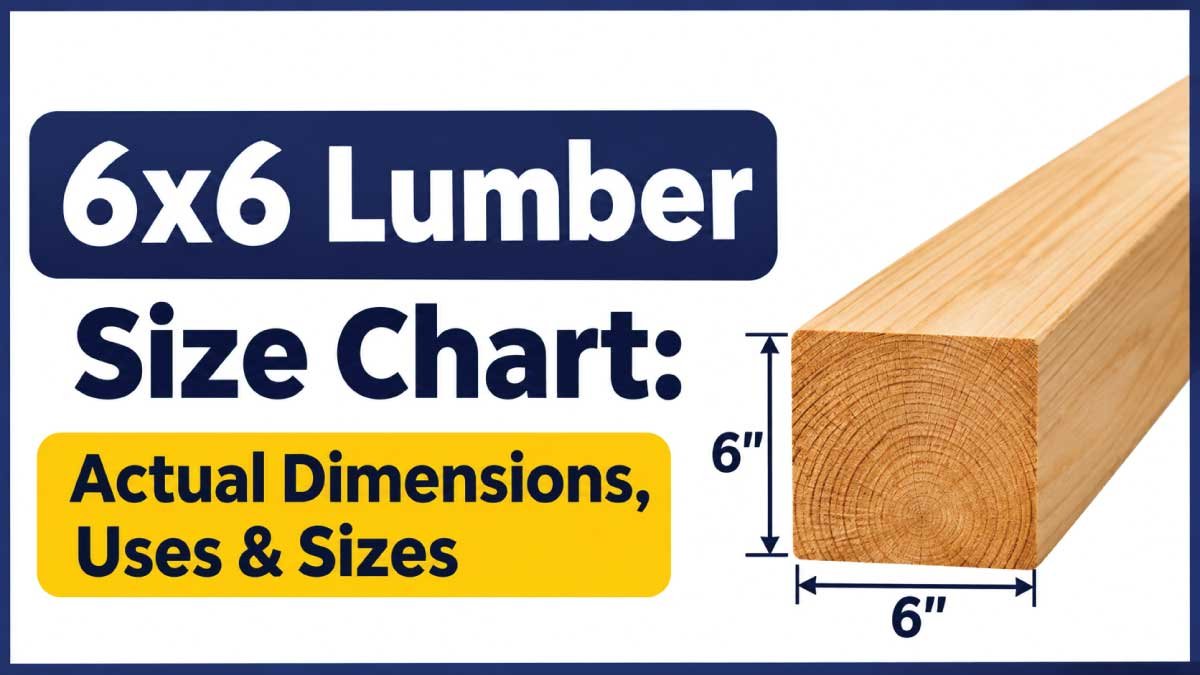
A 6×6 lumber piece may sound like it should measure exactly 6 inches by 6 inches, but that is not usually the case. Like other dimensional lumber, 6×6 lumber has a nominal size and an actual size, and understanding the difference is important when planning a construction or woodworking project. A standard surfaced 6×6 commonly measures about 5.5 inches × 5.5 inches, although dimensions can vary depending on whether the lumber is surfaced, rough-sawn, treated, or supplied by a particular manufacturer.
Because of its substantial cross section, 6×6 lumber is commonly used for structural posts, deck supports, pergolas, patio covers, columns, fences, landscaping projects, and other heavy-duty applications. It is available in different wood species, grades, treatments, and lengths, so choosing the right product involves more than simply looking at the size stamped on the lumber.
In this 6×6 lumber size guide, you’ll learn the difference between nominal and actual dimensions, common 6×6 lengths, board-foot calculations, typical applications, and how 6×6 compares with sizes such as 4×4 and 8×8. Whether you’re buying lumber for a new project or checking dimensions against a construction plan, this guide will help you understand exactly what to expect from a 6×6.
Understanding 6×6 Lumber: Nominal vs. Actual Size
When a lumber supplier, contractor, or building plan calls for a 6×6, the name can be misleading if you are expecting a piece of wood that measures exactly 6 inches by 6 inches. In most cases, a standard surfaced 6×6 board has actual dimensions of approximately 5.5 inches × 5.5 inches.
The term “6×6” is the nominal lumber size. Nominal dimensions describe the rough-sawn size of a piece of lumber before it is surfaced, dried, and processed. During manufacturing, wood is planed and finished to create a smoother, more uniform product, which reduces its final dimensions.
This distinction matters when you are designing a structure, calculating material quantities, installing posts, or determining whether a piece will fit into an existing opening.
A typical 6×6 is therefore:
- Nominal size: 6 inches × 6 inches
- Common actual size: 5.5 inches × 5.5 inches
- Actual cross-sectional area: 30.25 square inches
- Nominal cross-sectional area: 36 square inches
- Common uses: posts, beams, columns, pergolas, decks, retaining structures, and heavy-duty framing
The exact finished measurement can vary somewhat depending on the lumber type, manufacturing process, moisture condition, and whether the material is rough-sawn or surfaced.
For projects where precise dimensions are important, always measure the actual piece or check the supplier’s published specifications rather than relying only on the 6×6 name.
6×6 Lumber Size Chart
Once the difference between nominal and actual dimensions is clear, the standard 6×6 size becomes much easier to understand. The chart below shows common dimensions and characteristics associated with standard surfaced 6×6 lumber.
| Specification | 6×6 Lumber |
|---|---|
| Nominal width | 6 inches |
| Nominal thickness | 6 inches |
| Common actual width | 5.5 inches |
| Common actual thickness | 5.5 inches |
| Common actual cross-sectional area | 30.25 sq. in. |
| Common standard lengths | 8, 10, 12, 14, 16, 18, 20 ft |
| Typical form | Rough or surfaced |
| Common materials | Pine, Douglas fir, cedar, treated lumber |
| Common applications | Posts, beams, columns, outdoor structures |
The 5.5-inch actual dimension is especially important when laying out a project. For example, if you need a post to fit inside a space that is exactly 6 inches wide, a standard surfaced 6×6 may fit, but a rough-sawn 6×6 could be larger.
Likewise, if a drawing specifies a 6-inch structural member, you should not automatically assume that a standard 6×6 will provide exactly 6 inches of finished material.
What Are the Actual Dimensions of a 6×6?
The most common actual dimensions of a surfaced 6×6 are 5.5 inches by 5.5 inches.
That means the finished piece is approximately half an inch smaller in each direction than its nominal name suggests. This is normal for dimensional lumber and is not necessarily a defect or manufacturing problem.
The difference comes primarily from the preparation of the lumber.
Trees are initially sawn into rough dimensions that are larger than the final finished product. The boards are then dried and surfaced to produce consistent faces and edges. Removing material during this process results in the smaller actual dimensions found in retail lumber.
Why is a 6×6 not actually 6×6 inches?
The simplest explanation is that nominal lumber sizes refer to the approximate rough-sawn dimensions, while actual dimensions describe the finished product.
For example:
- A nominal 2×4 is commonly about 1.5 × 3.5 inches.
- A nominal 4×4 is commonly about 3.5 × 3.5 inches.
- A nominal 6×6 is commonly about 5.5 × 5.5 inches.
This sizing convention has been used throughout the lumber industry for many years.
It is also why construction plans often identify lumber by nominal size even though the physical pieces purchased from a lumberyard have smaller measurements.
Can a 6×6 actually measure 6×6 inches?
Yes, depending on the product.
A rough-sawn 6×6 may be much closer to the nominal 6-inch dimension because its surfaces have not been planed down to the same extent as surfaced dimensional lumber.
This distinction is particularly relevant for timber framing, landscaping timbers, heavy timber construction, and decorative applications where rough texture is desirable.
If a project requires an exact 6-inch finished dimension, confirm whether the specification calls for rough-sawn timber, surfaced lumber, or another specific wood product.
6×6 Lumber Standard Lengths
6×6 lumber is available in several lengths, although availability depends on the wood species, grade, treatment, supplier, and local market.
Common lengths include:
| Nominal Size | Common Lengths |
|---|---|
| 6×6 | 8 ft |
| 6×6 | 10 ft |
| 6×6 | 12 ft |
| 6×6 | 14 ft |
| 6×6 | 16 ft |
| 6×6 | 18 ft |
| 6×6 | 20 ft |
Longer lengths may be available for particular species or specialty structural products.
When purchasing, it is worth considering the finished length you actually need rather than simply buying the longest pieces available. Longer lumber can be harder to transport, handle, store, and cut.
For a project requiring several posts, plan the cutting layout before purchasing. A little planning can reduce offcuts and help you determine whether shorter stock will work just as well.
How Much Does a 6×6 Weigh?
There is no single weight for a 6×6 because lumber weight depends on several factors.
The biggest variables include:
- Wood species
- Moisture content
- Lumber length
- Treatment
- Density
- Grade
- Whether the lumber is green, kiln-dried, or air-dried
A dry 6×6 made from a relatively lightweight species can weigh considerably less than a wet, pressure-treated piece of the same dimensions.
Pressure-treated lumber can also be noticeably heavier when it is freshly treated because the wood may contain additional moisture and treatment chemicals.
For this reason, avoid estimating the exact weight of a 6×6 from its dimensions alone when planning transportation or lifting.
If you are working with long 6×6 posts, remember that even a relatively lightweight species becomes difficult to handle because of the material’s large cross section and length.
For construction planning, use the manufacturer’s or supplier’s published weight when a precise load calculation is required.
6×6 Lumber by Wood Type
The dimensions of a 6×6 can remain similar while its performance, appearance, durability, and weight change considerably depending on the wood species.
Pressure-Treated 6×6 Lumber
Pressure-treated 6×6 lumber is commonly used for outdoor construction where the wood may be exposed to moisture or direct contact with the ground, depending on the treatment rating and product specification.
Typical applications include:
- Deck posts
- Fence posts
- Pergola supports
- Outdoor structures
- Landscaping applications
- Certain retaining-wall components
Not every treated 6×6 is suitable for every type of ground contact. Always check the product label and treatment category before installation.
Douglas Fir 6×6
Douglas fir is widely used in structural construction because of its strength and stiffness characteristics. It may be used for posts, beams, columns, and other load-bearing applications when the appropriate grade and engineering requirements are met.
The species itself is not enough to determine whether a particular piece is suitable for a structural application. Grade, moisture condition, defects, span, connections, and load all matter.
Cedar 6×6
Cedar is popular for outdoor projects because of its appearance and natural resistance characteristics. It is frequently selected for posts, pergolas, garden structures, fences, and other visible applications.
Cedar can be lighter and softer than some structural species, so its suitability depends on the specific design and intended use.
Southern Yellow Pine 6×6
Southern Yellow Pine is commonly available in structural and pressure-treated lumber products. Treated versions are frequently used for outdoor posts and other applications where resistance to decay is important.
As with other lumber, the correct grade and treatment level should be selected according to the project’s requirements.
Common Uses for 6×6 Lumber
A 6×6 is substantially larger than common wall framing lumber, making it useful where a project needs a substantial post or timber.
Deck Posts
One of the most familiar applications is supporting decks and elevated outdoor structures.
A 6×6 can provide a large bearing surface and substantial cross section. However, the fact that a post is 6×6 does not automatically mean it is suitable for a particular deck.
Post height, tributary load, connection details, footing design, species, grade, and local building requirements all affect the design.
Pergolas and Patio Covers
The large appearance of a 6×6 makes it popular for pergolas, patio covers, and outdoor shade structures.
Compared with smaller posts, 6×6 lumber can create a heavier architectural appearance. It is especially common in designs where the support posts are intentionally visible.
Fence Posts
Large wood posts can be used for privacy fences, agricultural fencing, gates, and other heavy-duty fence applications.
For fence posts, the choice between 4×4, 6×6, and other sizes depends on fence height, wind exposure, spacing, gate loads, soil conditions, and design.
Timber Columns and Supports
6×6 lumber may also serve as a vertical column or support member in structures where the selected species and grade are appropriate.
For structural work, do not choose lumber based only on its physical size. The engineering properties and design loads are equally important.
Landscaping Projects
6×6 timbers are sometimes used in landscaping for raised beds, steps, borders, terraces, and retaining applications.
When lumber is used against soil, moisture exposure becomes a major consideration. Use an appropriate product and follow installation requirements for the specific application.
6×6 vs. 4×4 Lumber
The difference between a 4×4 and a 6×6 is more significant than the two-inch difference in the product names might suggest.
A typical surfaced 4×4 measures about 3.5 × 3.5 inches, while a typical surfaced 6×6 measures about 5.5 × 5.5 inches.
| Feature | 4×4 | 6×6 |
|---|---|---|
| Nominal size | 4 × 4 in. | 6 × 6 in. |
| Common actual size | 3.5 × 3.5 in. | 5.5 × 5.5 in. |
| Cross-sectional area | 12.25 sq. in. | 30.25 sq. in. |
| Typical appearance | Medium-sized post | Heavy, substantial post |
| Common applications | Fences, small structures | Posts, beams, larger structures |
The cross-sectional area illustrates why the larger member can look and behave very differently.
A 6×6 has about 2.47 times the cross-sectional area of a 4×4 based on their common actual dimensions. That does not mean a 6×6 has exactly 2.47 times the structural capacity, because structural capacity depends on much more than cross-sectional area.
For a load-bearing application, the correct size should be determined from the complete design rather than from a simple size comparison.
Also Read:
6×6 vs. 8×8 Lumber
An 8×8 is another option for projects requiring a large timber or visually substantial support.
A typical surfaced 8×8 may measure approximately 7.5 × 7.5 inches, although actual dimensions vary by product.
| Feature | 6×6 | 8×8 |
|---|---|---|
| Nominal size | 6 × 6 in. | 8 × 8 in. |
| Common actual size | 5.5 × 5.5 in. | 7.5 × 7.5 in. |
| Cross-sectional area | 30.25 sq. in. | 56.25 sq. in. |
| Appearance | Large | Very substantial |
| Typical use | Posts and medium/heavy timber applications | Large posts, timber structures, specialty applications |
An 8×8 contains substantially more wood than a 6×6, so it is also heavier and generally more difficult to handle.
Choosing the larger size is not automatically better. The appropriate member depends on structural calculations, connection details, available space, cost, appearance, and construction requirements.
Also Read:
How to Choose the Right 6×6 Lumber
Choosing the correct 6×6 involves more than checking its width and thickness.
Check the Species
Different species have different strength, density, durability, appearance, and workability characteristics.
Select a species appropriate for the environment and application rather than choosing solely based on price.
Check the Grade
For structural applications, lumber grade is extremely important.
Two pieces with identical dimensions can have different structural properties because of differences in knots, slope of grain, density, defects, and grading rules.
If a project has structural requirements, use lumber that meets the specified grade.
Check the Treatment
For exterior or ground-contact applications, determine whether the lumber is treated and whether the treatment is approved for the intended exposure.
Do not assume that all pressure-treated lumber is interchangeable.
Measure the Actual Lumber
If the fit is critical, take an actual measurement.
A piece labeled 6×6 will commonly be approximately 5.5 × 5.5 inches when surfaced, but the exact measurement can vary.
This simple step can prevent problems with brackets, post bases, notches, openings, and other connections.
Also Read:
6×6 Lumber for Outdoor Projects
Outdoor projects expose lumber to conditions that indoor framing normally does not experience.
Rain, humidity, sunlight, insects, soil contact, and repeated wetting and drying can all affect wood over time.
When using 6×6 lumber outside, consider:
- Whether the post will contact the ground
- Local moisture conditions
- Drainage around the post
- Appropriate pressure treatment
- End-grain exposure
- Fastener compatibility
- Protective coatings when appropriate
- Proper post-base or foundation details
Keeping wood away from unnecessary standing water is particularly important.
A well-designed post installation should not depend solely on the lumber being large. Water management, drainage, connections, and foundation details all contribute to long-term performance.
How to Cut and Handle 6×6 Lumber
Because 6×6 lumber is large and heavy compared with ordinary framing boards, handling it requires more planning.
Before cutting, support the material properly and make sure the work area provides enough room for the full length of the piece.
A 6×6 can also require different cutting approaches depending on the saw and blade capacity. A standard circular saw may not cut completely through a 5.5-inch-thick member in one pass.
For larger cuts, builders may use appropriate large-capacity saws or make controlled cuts from multiple sides.
When handling long posts:
- Use enough people for safe lifting.
- Keep the material supported while cutting.
- Do not balance long lumber in an unstable position.
- Use proper lifting equipment when necessary.
- Wear appropriate eye and hearing protection when operating power tools.
Pressure-treated lumber may also require specific handling practices and compatible fasteners. Follow the treatment manufacturer’s instructions.
How Many Board Feet Are in a 6×6?
Board-foot calculations are useful when estimating lumber quantities.
One board foot is equal to a board measuring 1 inch thick × 12 inches wide × 12 inches long.
The basic formula is:
Board feet = Thickness × Width × Length ÷ 144
For a nominal 6×6, the calculation uses the nominal dimensions when estimating board-foot quantity:
6 × 6 × length in feet ÷ 12
For example, a nominal 6×6 that is 8 feet long contains:
6 × 6 × 8 ÷ 12 = 24 board feet
A 12-foot 6×6 contains:
6 × 6 × 12 ÷ 12 = 36 board feet
This method is useful for estimating lumber volume and comparing material quantities, although retailers may price dimensional lumber by piece rather than by board foot.
6×6 Lumber Board-Foot Chart
For quick reference, the approximate board-foot content of common 6×6 lengths is shown below.
| 6×6 Length | Approx. Board Feet |
|---|---|
| 8 ft | 24 |
| 10 ft | 30 |
| 12 ft | 36 |
| 14 ft | 42 |
| 16 ft | 48 |
| 18 ft | 54 |
| 20 ft | 60 |
These figures are based on the nominal 6 × 6 dimensions used in the board-foot formula.
They should not be confused with the actual finished dimensions of surfaced lumber.
Common Mistakes When Buying 6×6 Lumber
Buying the wrong lumber can create unnecessary cutting, fitting, and construction problems. Several mistakes are easy to avoid.
Assuming the Lumber Is Exactly 6 Inches
The most common mistake is treating the product name as the exact finished measurement.
Remember that a standard surfaced 6×6 is commonly around 5.5 × 5.5 inches.
Ignoring Treatment Requirements
Outdoor lumber needs to match its intended exposure. A standard untreated board may not be appropriate for an application involving prolonged moisture or ground contact.
Choosing by Size Alone
A bigger post is not automatically the correct structural solution. Species, grade, length, load, connections, and support conditions all matter.
Not Checking for Straightness
Large lumber can have bow, crook, twist, or other characteristics that affect installation.
When possible, inspect individual pieces before purchasing, particularly when appearance matters.
Forgetting Transportation and Handling
A 16- or 20-foot 6×6 is considerably more difficult to transport and maneuver than a short post.
Plan how the lumber will be moved from the supplier to the work area before purchasing long lengths.
Frequently Asked Questions About 6×6 Lumber
Is a 6×6 actually 6 inches by 6 inches?
Usually not. A standard surfaced 6×6 commonly measures about 5.5 inches × 5.5 inches. Rough-sawn products may be closer to the nominal dimension.
What is the actual size of a pressure-treated 6×6?
A pressure-treated dimensional 6×6 is commonly around 5.5 × 5.5 inches, although actual measurements can vary by manufacturer and product.
Treatment and moisture can also affect the dimensions slightly.
What lengths does 6×6 lumber come in?
Common lengths include 8, 10, 12, 14, 16, 18, and 20 feet. Availability varies by species, treatment, grade, supplier, and location.
Is 6×6 stronger than 4×4?
A 6×6 has a substantially larger cross section than a 4×4, but structural strength cannot be determined from size alone. Species, grade, length, loading, connections, and installation conditions all influence capacity.
Can 6×6 lumber be used for deck posts?
Yes, 6×6 lumber is commonly used for deck posts, but the appropriate size, species, grade, treatment, footing, spacing, and connections depend on the deck design and applicable building requirements.
Can a 6×6 be used for a beam?
A 6×6 may be suitable for certain beam or timber applications, but whether it works depends on span, loads, species, grade, support conditions, and design requirements. A larger-looking piece is not automatically an adequate beam.
How do I calculate the board feet in a 6×6?
Use the nominal dimensions:
6 × 6 × length in feet ÷ 12
An 8-foot 6×6 therefore contains approximately 24 board feet, while a 16-foot 6×6 contains approximately 48 board feet.
Final 6×6 Lumber Size Guide
The key point to remember is simple: 6×6 describes the nominal size, not necessarily the finished measurement.
For standard surfaced dimensional lumber, the actual size is commonly around 5.5 × 5.5 inches. Rough-sawn timber can be different, so always check the product specifications when exact dimensions matter.
A 6×6 is a substantial piece of lumber and is commonly selected for posts, columns, outdoor structures, heavy-duty fencing, landscaping, and other applications where a larger timber is useful.
Before purchasing, consider the complete picture:
- Confirm the actual dimensions.
- Choose the appropriate wood species.
- Check the lumber grade for structural work.
- Verify treatment requirements for outdoor use.
- Select a suitable length.
- Inspect the lumber for excessive bow, twist, or damage.
- Plan transportation and handling.
- Use appropriate connections and installation methods.
- Follow local building requirements for structural projects.
Most importantly, don’t choose a 6×6 simply because it looks strong enough. For load-bearing construction, the correct lumber depends on the entire design. A properly selected and installed member should match the project’s loads, span, supports, connections, environment, and applicable building requirements.
Understanding nominal and actual dimensions is the first step. Once that distinction is clear, the rest of the 6×6 lumber size chart becomes much easier to use when planning a project, estimating materials, or comparing different lumber options.